Center for Organoid Systems (COS)
TUM opens new center for mini-organs

In brief
-
New biotechnology center on the TUM campus in Garching conducts organoid research
-
Tools for basic research and a pathway to innovative therapies
-
Opening Ceremony with Bavarian Science Minister Markus Blume
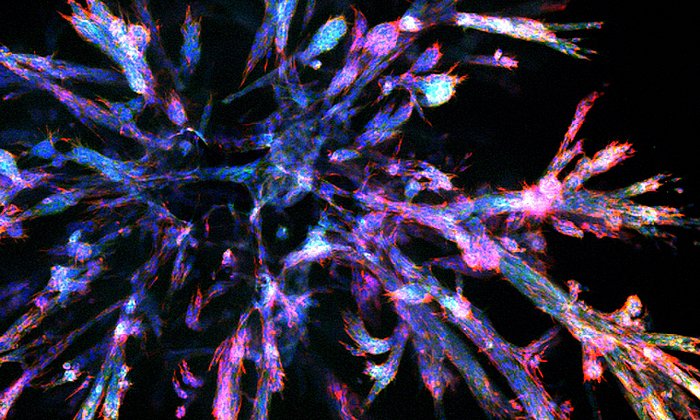
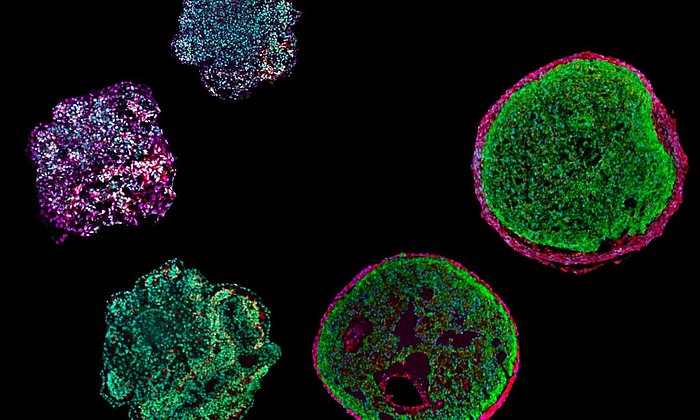
Organoids are three-dimensional structures that typically consist of multiple interacting cell types. At COS, they are grown from stem cells or human tissue. Because of their structure and cellular composition, organoids more closely mimic what actually occurs in the body than conventional cell cultures. At the same time, because they contain fewer cell types, organoid experiments can be controlled more easily than animal models.
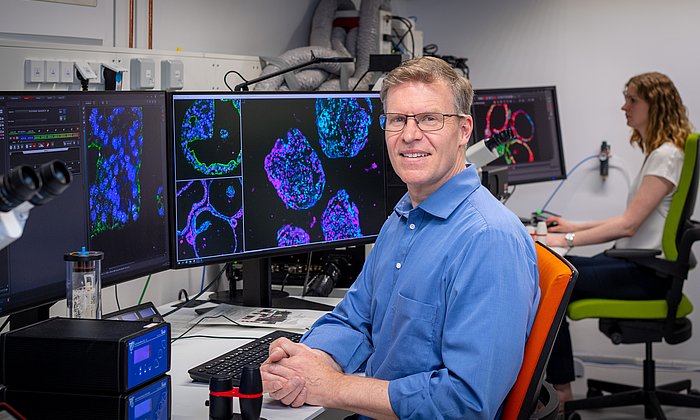
For these reasons, organoids are a rapidly growing area of research that is currently advancing at remarkable speed. An increasing number of organ functions can now be replicated with ever greater precision. According to Matthias Hebrok, Professor of Applied Stem Cell and Organoid Systems and Director of the COS, it is only a matter of time before researchers can create miniature organs that fully reproduce the properties of their biological counterparts. Such advances are not only relevant for basic research. Organoid-based therapies could, for example, replace impaired organ functions through cell-based treatments. To bring these therapies into clinical practice as quickly as possible, COS researchers in Garching work closely with colleagues at the TUM University Hospital.
New building offers high-tech infrastructure
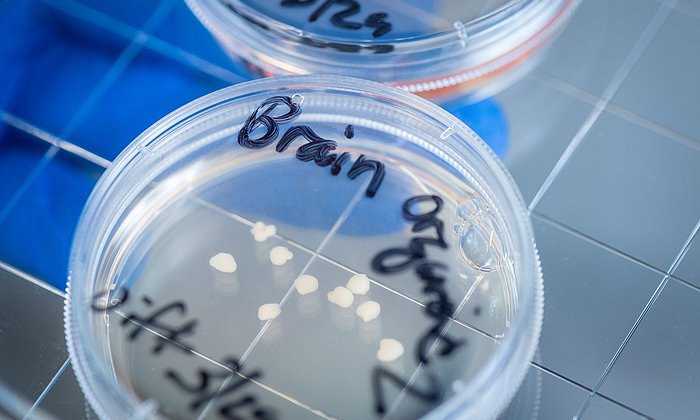
The opening of the COS adds a new state-of-the-art research building to the Garching campus, bringing organoid research teams together under one roof. Nine research groups currently study different types of organoids, including pancreatic, liver, and brain organoids. Another important research focus is the development of organoid-based disease models, including cancer models that can serve as tools for personalized medicine. One of the center's goals is to combine different organoid types in order to investigate interactions between organs.
Two COS members recently received prestigious ERC Starting Grants from the European Research Council: liver organoid researcher Anna Dowbaj and Julian Grünewald, an expert on the CRISPR-Cas gene-editing tool.
Researchers in the new building benefit not only from close collaboration but also from advanced technical infrastructure. A core facility funded by the Heinz Nixdorf Foundation, for example, includes a laboratory robot capable of cultivating large numbers of organoids according to precise specifications. This automated process enables the high-throughput production of highly reproducible organoids. Such reproducibility is also considered a key prerequisite for the long-term goal of replacing some animal experiments with organoid-based methods.
- Prof. Andreas Bausch - Biomechanics of Organoids
- Prof. Anna Dowbaj - Liver Organoids
- Prof. Julian Grünewald - CRISPR-Cas Applications in Heart Disease
- Prof. Matthias Hebrok - Pancreatic Organoids
- Prof. Alessandra Moretti - Heart Organoids
- Prof. Maximilian Reichert - Pancreatic Cancer Organoids
- Prof. Simon Schäfer - Brain Organoids
- Prof. Melanie Schirmer - Gut Microbiome
- Prof. Bernhard Wolfrum - Neuroelectronic Interfaces
Connecting medicine, engineering, and the natural sciences
Bavaria's Science Minister, Markus Blume, emphasizes: "Organs grown in the lab? At the COS, that is no longer science fiction. At the new Center for Organoid Systems, miniature organs are emerging as powerful new tools for medical research. Outstanding scientists are investigating what happens in the human body during diseases such as cancer, diabetes, and cardiovascular disorders, and how these insights can be translated into new therapies. To make this possible, the COS brings together stem cell research, medicine, engineering, and computer science under one roof, creating vital connections across disciplines. Through the Hightech Agenda Bavaria, we are providing the infrastructure needed for this kind of world-class research. Equally impressive is the speed at which this state-of-the-art research center has been built.The center was built in a remarkably short time and combines sustainable timber construction with cutting-edge research infrastructure. Working closely with TUM University Hospital, researchers can move discoveries from the laboratory into medical applications more quickly. The COS shows that when outstanding minds, excellent infrastructure, and close collaboration come together, scientific research can be translated into medical advances much faster.
TUM President Thomas F. Hofmann said: “The COS marks the next milestone in the deep integration of our medical research with the natural sciences, engineering, and computer science under the organizational umbrella of the Munich Institute for Biomedical Engineering (MIBE). With this modular research building – funded with a total of more than 40 million Euros from the Bavarian High-Tech Agenda, the Heinz Nixdorf Foundation, and TUM – we are giving our outstanding medical research a visible presence on the Garching campus and building scientific bridges to the TUM Center for Functional Protein Assemblies and microbiome research on the Weihenstephan campus.”
Medicine
How do we treat serious diseases like cancer, diabetes or Alzheimer's? Learn more about our research in medicine as well as health and sport sciences.
Medicine and Health

The composition of the COS Board of Directors reflects this interdisciplinary collaboration. Matthias Hebrok, an expert in pancreatic organoids and Executive Director of the COS, is joined by Prof. Andreas Bausch, Director of the Center for Functional Protein Assemblies, and Prof. Maximilian Reichert, an expert in pancreatic cancer at TUM University Hospital. The Managing Director of the COS is PD Dr. Bernhard Gleich, who also holds this position at its umbrella organization, MIBE.
“Whether we are collaborating with other institutes or working here under one roof with so many outstanding researchers, we can achieve a great deal together,” says Matthias Hebrok. “With the COS, we have created a facility that is unique in Europe. I am confident that over the coming years, we will make important contributions to basic research and innovative new therapeutic approaches.”
Technical University of Munich
Corporate Communications Center
- Paul Hellmich
- paul.hellmich@tum.de
- presse@tum.de
- Teamwebsite
Contacts to this article:
Prof. Dr. Matthias Hebrok
Technical University of Munich
Chair of Applied Stem Cell and Organoid Systems
matthias.hebrok@tum.de