<?xml version="1.0" encoding="utf-8"?>
<?xml-stylesheet type="text/css" href="/typo3conf/ext/in2template/Resources/Public/Css/rss.css" ?>


<feed xmlns="http://www.w3.org/2005/Atom">
	<title>TUM – Latest news</title>
	<link href="https://www.tum.de/en/"/>
	<link rel="self" href="https://www.tum.de/en/news-and-events/events/presidential-lunches/news.rss"/>
	<id>https://www.tum.de/en/news-and-events/events/presidential-lunches</id>
	<updated>2026-03-09T15:25:32+01:00</updated>
	
		
			<entry>
				<id>https://www.tum.de/en/news-42099.atom</id>
				<title>Targeted Shaking Stabilizes Exotic Quantum States</title>
				<author>
					<name>Ulrich Meyer</name>
					
				</author>
        <published>2026-03-09T09:57:11+01:00</published>
        <updated>2026-03-09T11:49:00+01:00</updated>
				<link rel="alternate" type="text/html" href="https://www.tum.de/en/news-and-events/all-news/press-releases/details/targeted-shaking-stabilizes-exotic-quantum-states"/>
				<summary>Exotic quantum states are highly sought after because they store and process information in fundamentally different ways than classical systems. To generate them, quantum systems are often periodically &quot;shaken.&quot; In doing so, however, they typically absorb energy, heat up, and lose their structure - a major obstacle for quantum simulation and quantum computers. An international team of researchers has now succeeded in preventing this heating and creating stable, long-lived exotic states.</summary>
				<content type="xhtml">
				<div xmlns="http://www.w3.org/1999/xhtml">
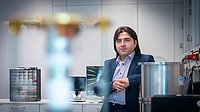
				   <img src="https://www.tum.de/fileadmin/user_upload_87/_processed_/3/3/csm_Foto_Knolle_208d0d3799.jpg" width="200" height="138" alt="" />
            <a title="Targeted Shaking Stabilizes Exotic Quantum States" href="https://www.tum.de/en/news-and-events/all-news/press-releases/details/targeted-shaking-stabilizes-exotic-quantum-states">
             Targeted Shaking Stabilizes Exotic Quantum States
            </a>
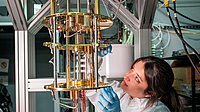
           <p>In a new study published in the journal Nature, the researchers show that unwanted heating can be drastically slowed down by randomly shaking a superconducting quantum computer with 78 qubits. Instead of adding energy through completely unstructured shaking, they use carefully designed patterns of random pulses that partially cancel each other out over time.
By directly measuring quantum entanglement in the processor, the team was able to track the system&#039;s evolution over more than a thousand driving cycles - far beyond what today&#039;s classical computers could simulate. The results show that even randomness, when carefully engineered, can be used to control complex quantum systems and explore new states of matter.
The quantum-theoretical predictions of the exotic systems now confirmed were developed during a research visit by then-doctoral student Hongzheng Zhao to the TUM School of Natural Sciences, where he worked with Prof. Johannes Knolle at his Professorship for Theory of Quantum Matter. Hongzheng Zhao has since become a professor at Peking University.
Experimental confirmation was achieved by a team led by Prof. Heng Fan at the Chinese Academy of Sciences, using a state-of-the-art &quot;Chuang-tzu 2.0&quot; quantum chip with 78 quantum particles (qubits). The Max Planck Institute for the Physics of Complex Systems in Dresden and Imperial College London were also involved in the research.</p>
         </div>
				</content>
			</entry>
		
			<entry>
				<id>https://www.tum.de/en/news-42080.atom</id>
				<title>&quot;Nobody has to start perfectly&quot; </title>
				<author>
					<name>Natalie Neudert – TUM CST Communications</name>
					<email>natalie.neudert@tum.de</email>
				</author>
        <published>2026-03-05T15:52:03+01:00</published>
        <updated>2026-03-09T11:41:43+01:00</updated>
				<link rel="alternate" type="text/html" href="https://www.tum.de/en/news-and-events/all-news/press-releases/details/nobody-has-to-start-perfectly"/>
				<summary>Studying electrical engineering and information technology is still considered a male domain – and many young women start it with the feeling that they are not well enough prepared. This is exactly where the TUM Student Club EI Girls comes in. In this interview, its leaders talk about how their community supports other female students.  </summary>
				<content type="xhtml">
				<div xmlns="http://www.w3.org/1999/xhtml">
				   <img src="https://www.tum.de/fileadmin/user_upload_87/_processed_/3/5/csm_20260303_092024000_iOS__1__9dfa8be5a2.jpg" width="200" height="113" alt="" />
            <a title="&quot;Nobody has to start perfectly&quot; " href="https://www.tum.de/en/news-and-events/all-news/press-releases/details/nobody-has-to-start-perfectly">
             &quot;Nobody has to start perfectly&quot; 
            </a>
           <p></p>
         </div>
				</content>
			</entry>
		
			<entry>
				<id>https://www.tum.de/en/news-42012.atom</id>
				<title>How fires, storms, and bark beetles will shape the future of Europe’s forests</title>
				<author>
					<name>Anja Lapac</name>
					
				</author>
        <published>2026-03-05T14:33:00+01:00</published>
        <updated>2026-03-05T20:04:07+01:00</updated>
				<link rel="alternate" type="text/html" href="https://www.tum.de/en/news-and-events/all-news/press-releases/details/how-fires-storms-and-bark-beetles-will-shape-the-future-of-europes-forests"/>
				<summary>Wildfires, storms, and bark beetles have a major impact on forests and the benefits they provide for people and the environment. For the first time, a large international team led by researchers at the Technical University of Munich (TUM) has calculated how disturbances could transform Europe’s forests by 2100. Even in the most optimistic scenario, the team foresees a substantial increase in damaged forest area—in the most pessimistic case, disturbances could even double.</summary>
				<content type="xhtml">
				<div xmlns="http://www.w3.org/1999/xhtml">
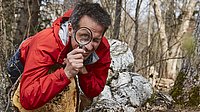
				   <img title="Tree trunks with clearly visible bark beetle damage: large areas of bark are missing, and the trunks appear severely affected." alt="Tree trunks with clearly visible bark beetle damage: large areas of bark are missing, and the trunks appear severely affected." src="https://www.tum.de/fileadmin/_processed_/1/6/csm_Seidl_Waldschaeden_3062f42842.jpg" width="200" height="112" />
            <a title="How fires, storms, and bark beetles will shape the future of Europe’s forests" href="https://www.tum.de/en/news-and-events/all-news/press-releases/details/how-fires-storms-and-bark-beetles-will-shape-the-future-of-europes-forests">
             How fires, storms, and bark beetles will shape the future of Europe’s forests
            </a>
           <p>Tree mortality is not new; it is a part of natural forest dynamics—where old trees die, young trees regenerate and form the next generation of canopy trees. What is new is the scale at which wildfires, storms, and bark beetles—fueled by climate change—are reshaping forests. Recent years have already shown dramatic levels of forest damage in Central Europe, but until now it was unclear how much forest area might be affected by disturbances in the future. Disturbances determine how much carbon forests can store, how much timber they can provide, and which species they provide habitat for—making the findings highly relevant for policymakers and society.
This knowledge gap has now been filled by a large team of researchers led by Rupert Seidl, Professor of Ecosystem Dynamics and Forest Management at TUM. The researchers estimate that with global warming of just over 4 degrees Celsius, the area disturbed by fires, storms, and bark beetles could more than double by 2100. As a baseline, the researchers used remotely sensed data from 1986 to 2020—a period that already saw unusually high levels of forest disturbance. Even in the best‑case scenario, with warming limited to roughly 2 degrees Celsius, the researchers expect more forest damage in the future than during this reference period.</p>
         </div>
				</content>
			</entry>
		
			<entry>
				<id>https://www.tum.de/en/news-42049.atom</id>
				<title>Successful robotics incubator at TUM receives further funding</title>
				<author>
					<name>Andreas Schmitz</name>
					
				</author>
        <published>2026-03-04T08:00:00+01:00</published>
        <updated>2026-03-04T08:26:54+01:00</updated>
				<link rel="alternate" type="text/html" href="https://www.tum.de/en/news-and-events/all-news/press-releases/details/successful-robotics-incubator-at-tum-receives-further-funding"/>
				<summary>The Bavarian Ministry of Economic Affairs is extending its support for the robo.innovate robotics incubator at the Technical University of Munich (TUM) and is providing €3.5 million in funding for the next three and a half years. In this funding phase, robotics manufacturer NEURA Robotics is also joining as the important first industry sponsor. Start-ups supported by robo.innovate attracted €52 million in investments during the first few years (2022 to 2025).</summary>
				<content type="xhtml">
				<div xmlns="http://www.w3.org/1999/xhtml">
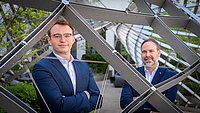
				   <img title="Nicole Ebner, Prof. Eckehard Steinbach (2. v.l.) und Lorenzo Masia (li.) sprechen im Munich Urban Colab über die Perspektiven von Start-ups. " src="https://www.tum.de/fileadmin/_processed_/c/8/csm_Aufmacher__SPICE-25-3-Dec-2025-0536Steffen_Kastner_e06278d1c8.jpg" width="200" height="113" alt="" />
            <a title="Successful robotics incubator at TUM receives further funding" href="https://www.tum.de/en/news-and-events/all-news/press-releases/details/successful-robotics-incubator-at-tum-receives-further-funding">
             Successful robotics incubator at TUM receives further funding
            </a>
           <p>The robo.innovate initiative, launched at the end of 2021, supports founders from the initial idea all the way to a prototype and a marketable product. „We connect and support students, researchers, industry and investors in start-up projects and accompany founding teams on their journey from an idea to a successful company,“ says robo.innovate Managing Director Nicole Ebner. Among other things, the incubator provides students with office space and access to the work spaces of UnternehmerTUM MakerSpace. Twice a year, robo.innovate also invites selected experts in robotics and AI to the exclusive SPICE event and organizes a robotics-specific hackathon, as well as various networking meetings and specialist workshops tailored specifically to the needs of robotics/AI.
More than 100 start-ups in four years 
The initiative has already supported more than 100 start-ups to date. In the experience of robo.innovate co-initiator and project manager Prof. Eckehard Steinbach of the Munich Institute of Robotics and Machine Intelligence (MIRMI), around half of the teams supported go on to found their own start-up. „In total, our robotics start-ups have generated 52 million euros in revenue over the last four years,“ says Steinbach. The start-ups include biodiversity specialists Hula Earth, the developers of trash-picking robots at Angsa Robotics, and the team at Olive Robotics with their modular robotics system.&amp;nbsp;&amp;nbsp;
&quot;The fact that we are now receiving funding from the Bavarian Ministry of Economic Affairs for another three and a half years validates our approach. robo.innovate is highly familiar with the ecosystem of university research, industry, investors, start-ups and public funding agencies and can provide potential founders with targeted access to all relevant networks related to robotics, AI, medical technology, manufacturing and related technologies,&quot; says Prof. Eckehard Steinbach, Member of the Board of TUM MIRMI and Head of the Chair of Media Technology at TUM.
Bavaria&#039;s Minister of Economic Affairs Hubert Aiwanger says: &quot;robo.innovate helps young talents in transform ideas in the future-oriented fields of robotics and AI into viable business models. This gives Bavaria&#039;s economy a powerful boost: New start-ups are emerging, and innovations are flowing into existing companies through contracts and collaborations. We have therefore extended funding for robo.innovate until 30 June 2029 and increased it to a total of over EUR 7 million. I am delighted that so many teams have already been successful and that the Gründerland Bayern initiative has been able to accompany them on their journey. My thanks also go to the first sponsor from the industry sector!&quot;
&quot;Complex, intelligent robotics should come from Germany. That&#039;s why we support those who want to shape the future of this technology with new ideas and entrepreneurial courage. robo.innovate is an ideal platform for this. We are delighted to support the initiative and thus assist many young talents and start-up teams on their way to the robotics of tomorrow,&quot; says David Reger, CEO and founder of NEURA Robotics.</p>
         </div>
				</content>
			</entry>
		
			<entry>
				<id>https://www.tum.de/en/news-42039.atom</id>
				<title>Urban trees can absorb more CO₂ than cars emit during summer</title>
				<author>
					<name>Julia Rinner</name>
					<email>julia.rinner@tum.de</email>
				</author>
        <published>2026-03-03T09:00:00+01:00</published>
        <updated>2026-03-03T13:12:11+01:00</updated>
				<link rel="alternate" type="text/html" href="https://www.tum.de/en/news-and-events/all-news/press-releases/details/urban-trees-can-absorb-more-co2-than-cars-emit-during-summer"/>
				<summary>How much carbon dioxide do parks and individual trees in cities absorb, and how much do they release? To answer this question, researchers at the Technical University of Munich (TUM) have developed a high-resolution CO₂ biogenic flux model. Their findings show that, on average, around two percent of Munich&#039;s annual urban emissions are compensated by vegetation. Urban trees have the greatest impact, whereas grassy areas are often net sources of CO₂.</summary>
				<content type="xhtml">
				<div xmlns="http://www.w3.org/1999/xhtml">
				   <img title="Jia Chen is a professor of environmental sensing and modeling." alt="Professor Jia Chen can be seen from a distance, standing under a bridge. The large glass front of a building can be seen in the background." src="https://www.tum.de/fileadmin/_processed_/5/d/csm_20171020-_T2A9228_ADR_IsoV2_300_JEB_JuliEberleTUM_432e161d2c.jpg" width="200" height="112" />
            <a title="Urban trees can absorb more CO₂ than cars emit during summer" href="https://www.tum.de/en/news-and-events/all-news/press-releases/details/urban-trees-can-absorb-more-co2-than-cars-emit-during-summer">
             Urban trees can absorb more CO₂ than cars emit during summer
            </a>
           <p>According to the model, among all vegetation types, urban trees make the greatest contribution to offsetting carbon dioxide emissions in cities. On some summer days, their absorption can cover the emissions from Munich&#039;s urban traffic and even exceed them at times. Because soil respiration exceeds photosynthesis, grassy areas release more carbon dioxide than they bind and are therefore considered a source of CO₂ on an annual basis. Jia Chen, professor of environmental sensing and modeling, and her doctoral student Junwei Li conducted biospheric field measurements in urban parks from April 2024 to February 2025, to validate their model results.</p>
         </div>
				</content>
			</entry>
		
			<entry>
				<id>https://www.tum.de/en/news-42034.atom</id>
				<title>&quot;More technology does not mean more meaningful learning environments&quot;</title>
				<author>
					<name>Natalie Neudert – TUM CST Communications</name>
					<email>natalie.neudert@tum.de</email>
				</author>
        <published>2026-02-27T10:59:59+01:00</published>
        <updated>2026-02-27T13:21:25+01:00</updated>
				<link rel="alternate" type="text/html" href="https://www.tum.de/en/news-and-events/all-news/press-releases/details/more-technology-does-not-mean-more-meaningful-learning-environments"/>
				<summary>He began his studies during the coronavirus pandemic – initially purely digitally, later switching constantly between online and face-to-face formats. For Felix Jahn, it became clear at the time how strongly spaces shape learning processes. Today, he is completing a Master&#039;s degree in Architecture at TUM and is a Future Scout for the Stifterverband. In this interview, he explains how space, didactics and technology should interact at universities.</summary>
				<content type="xhtml">
				<div xmlns="http://www.w3.org/1999/xhtml">
				   <img title="TUM architecture student and Future Scout Felix Jahn" alt="TUM architecture student and Future Scout Felix Jahn" src="https://www.tum.de/fileadmin/user_upload_87/_processed_/e/b/csm_20260210_144210680_iOS_fc79682278.jpg" width="200" height="112" />
            <a title="&quot;More technology does not mean more meaningful learning environments&quot;" href="https://www.tum.de/en/news-and-events/all-news/press-releases/details/more-technology-does-not-mean-more-meaningful-learning-environments">
             &quot;More technology does not mean more meaningful learning environments&quot;
            </a>
           <p></p>
         </div>
				</content>
			</entry>
		
			<entry>
				<id>https://www.tum.de/en/news-42024.atom</id>
				<title>Why corals bleach</title>
				<author>
					<name>Laura Richter und Ulrich Meyer </name>
					
				</author>
        <published>2026-02-25T08:00:00+01:00</published>
        <updated>2026-02-25T14:51:19+01:00</updated>
				<link rel="alternate" type="text/html" href="https://www.tum.de/en/news-and-events/all-news/press-releases/details/why-corals-bleach"/>
				<summary>Rising sea temperatures are causing coral reefs around the world to bleach. For the first time, a research team at the Research Neutron Source Heinz Maier-Leibnitz (FRM II) at the Technical University of Munich (TUM) has investigated the biological processes behind coral bleaching directly in living corals. With the help of neutrons, they were able to visualise structural changes during the bleaching process.</summary>
				<content type="xhtml">
				<div xmlns="http://www.w3.org/1999/xhtml">
				   <img src="https://www.tum.de/fileadmin/user_upload_87/_processed_/7/3/csm_Korallenbleiche_7d5c4c2e44.jpg" width="200" height="113" alt="" />
            <a title="Why corals bleach" href="https://www.tum.de/en/news-and-events/all-news/press-releases/details/why-corals-bleach">
             Why corals bleach
            </a>
           <p>Coral reefs are important marine ecosystems, providing habitat, food, and shelter for countless species. Many coral species live in symbiosis with photosynthetic algae. The algae provide nutrients, while the corals offer protection and carbon dioxide in return. However, this symbiosis is extremely sensitive to rising sea temperatures.
Photosynthesis takes place in special membranes in algae, known as thylakoid membranes. When sea temperatures rise, this system becomes unbalanced because the excess energy can no longer be processed sufficiently. As a result, the corals reject the algae, losing both their colour and their most important source of energy: the corals bleach. They can survive short-term bleaching events, but if the loss of algae persists, the corals die.</p>
         </div>
				</content>
			</entry>
		
			<entry>
				<id>https://www.tum.de/en/news-42015.atom</id>
				<title>Designing proteins for targeted cell activation</title>
				<author>
					<name>Undine Ziller</name>
					<email>undine.ziller@tum.de</email>
				</author>
        <published>2026-02-23T13:35:38+01:00</published>
        <updated>2026-02-24T10:10:11+01:00</updated>
				<link rel="alternate" type="text/html" href="https://www.tum.de/en/news-and-events/all-news/press-releases/details/designing-proteins-for-targeted-cell-activation"/>
				<summary>Custom-designed proteins that can control cells and activate them in a targeted way: Thomas Schlichthärle wants to use them to advance the development of new medicines. In this new episode of “NewIn,” he explains how researchers in other disciplines can benefit from his methods.</summary>
				<content type="xhtml">
				<div xmlns="http://www.w3.org/1999/xhtml">
				   <img title="Prof. Dr. Thomas Schlichthaerle Arbeitsgruppe AI-guided Protein design, TUM School of Natural Sciences, Chemistry Department, Technische Universitaet Muenchen (TUM); Fotografiert am 18.07.2025 am TUM Campus Muenchen ; Foto: Astrid Eckert,  TU Muenchen; Ve" alt="Prof. Thomas Schlichthärle" src="https://www.tum.de/fileadmin/_processed_/d/a/csm_20250718_Prof_Thomas_Schlichthaerle_AE-198-2_893a31752c.jpg" width="200" height="113" />
            <a title="Designing proteins for targeted cell activation" href="https://www.tum.de/en/news-and-events/all-news/press-releases/details/designing-proteins-for-targeted-cell-activation">
             Designing proteins for targeted cell activation
            </a>
           <p></p>
         </div>
				</content>
			</entry>
		
			<entry>
				<id>https://www.tum.de/en/news-42008.atom</id>
				<title>Electrically Powered to the Scene</title>
				<author>
					<name>Ulrich Meyer</name>
					
				</author>
        <published>2026-02-23T08:00:00+01:00</published>
        <updated>2026-02-23T09:08:40+01:00</updated>
				<link rel="alternate" type="text/html" href="https://www.tum.de/en/news-and-events/all-news/press-releases/details/electrically-powered-to-the-scene"/>
				<summary>Sustainability is of particularly high importance at the Technical University of Munich (TUM) – not only in research and teaching, but naturally also in campus operations. Safety at the TUM Research Campus in Garching is ensured by the university’s own professional plant fire brigade, which now operates Bavaria’s first electrically powered fire engines.</summary>
				<content type="xhtml">
				<div xmlns="http://www.w3.org/1999/xhtml">
				   <img src="https://www.tum.de/fileadmin/user_upload_87/_processed_/a/5/csm_TUM_Feuerwehr_Fahrzeug_offen_e8105a389b.jpg" width="200" height="133" alt="" />
            <a title="Electrically Powered to the Scene" href="https://www.tum.de/en/news-and-events/all-news/press-releases/details/electrically-powered-to-the-scene">
             Electrically Powered to the Scene
            </a>
           <p>&amp;nbsp;A report by Bayerischer Rundfunk shows how well this concept works in practice.</p>
         </div>
				</content>
			</entry>
		
			<entry>
				<id>https://www.tum.de/en/news-42010.atom</id>
				<title>TUM Supports Innovation Campus for Circular Bioeconomy</title>
				<author>
					<name>Ulrich Meyer</name>
					
				</author>
        <published>2026-02-20T12:31:15+01:00</published>
        <updated>2026-02-23T13:24:00+01:00</updated>
				<link rel="alternate" type="text/html" href="https://www.tum.de/en/news-and-events/all-news/press-releases/details/tum-supports-innovation-campus-for-circular-bioeconomy"/>
				<summary>To strengthen regional energy and resource security, the Technical University of Munich (TUM) is partnering with Dominikus-Ringeisen-Werk (DRW). As part of the joint project “Living Lab Circular Bioeconomy,” an innovation campus is being established at the headquarters of the church-affiliated foundation in Ursberg, a historically significant monastery site. Around 1,000 people with support needs live there.</summary>
				<content type="xhtml">
				<div xmlns="http://www.w3.org/1999/xhtml">
				   <img src="https://www.tum.de/fileadmin/user_upload_87/_processed_/2/0/csm_Jenbacher_Ursberg_Luft0077_1141771df6.jpg" width="200" height="133" alt="" />
            <a title="TUM Supports Innovation Campus for Circular Bioeconomy" href="https://www.tum.de/en/news-and-events/all-news/press-releases/details/tum-supports-innovation-campus-for-circular-bioeconomy">
             TUM Supports Innovation Campus for Circular Bioeconomy
            </a>
           <p>From the TUM School of Natural Sciences, Prof. Tom Nilges, Prof. (em.) Johannes Lercher, and Prof. Jennifer Strunk are involved in the project. The researchers combine their expertise in innovative materials chemistry for batteries and hydrogen storage (Nilges), electrified reactors and catalysis for hydrogen production (Lercher), and chemical hydrogen storage and CO₂ conversion (Strunk). Together, they will analyze the potential of circular hydrogen technologies and electrical energy storage at the Ursberg site. The use of electrolyzers, battery systems, and strategies for material recovery from waste is intended to contribute to energy self-sufficiency and emission reductions.</p>
         </div>
				</content>
			</entry>
		
			<entry>
				<id>https://www.tum.de/en/news-42001.atom</id>
				<title>UnternehmerTUM again named Europe’s top start-up hub</title>
				<author>
					<name>Ulrich Meyer</name>
					
				</author>
        <published>2026-02-19T10:16:31+01:00</published>
        <updated>2026-03-05T09:56:03+01:00</updated>
				<link rel="alternate" type="text/html" href="https://www.tum.de/en/news-and-events/all-news/press-releases/details/unternehmertum-again-named-europes-top-startup-hub"/>
				<summary>For the third consecutive year, the British business newspaper Financial Times has named UnternehmerTUM Europe’s leading startup hub. Since the introduction of the “Europe’s Leading Startup Hubs” ranking, the ecosystem formed by Technical University of Munich (TUM), UnternehmerTUM, and TUM Venture Labs has consistently ranked first.</summary>
				<content type="xhtml">
				<div xmlns="http://www.w3.org/1999/xhtml">
				   <img src="https://www.tum.de/fileadmin/user_upload_87/_processed_/3/4/csm_Munich_Urban_Colab_Wintergarten_c_Munich_Urban_Colab_Stefan_Mueller-Naumann_45dbb749be.jpeg" width="200" height="133" alt="" />
            <a title="UnternehmerTUM again named Europe’s top start-up hub" href="https://www.tum.de/en/news-and-events/all-news/press-releases/details/unternehmertum-again-named-europes-top-startup-hub">
             UnternehmerTUM again named Europe’s top start-up hub
            </a>
           <p>The ecosystem connects startups, small and medium-sized enterprises, and large corporations in key future fields such as artificial intelligence and the circular economy. At TUM, entrepreneurship is firmly established as the third pillar alongside research and education. Here, business ideas can be tested at an early stage, risks can be reduced, and technologies can be brought to market quickly.
Prof. Helmut Schönenberger, Co-Founder and CEO of UnternehmerTUM and Vice President for Entrepreneurship at TUM, emphasizes: “Europe’s top ranking is no coincidence – it is the result of decades of concerted efforts within a unique high-tech ecosystem. As a high-performance startup factory, we support founders throughout their entire entrepreneurial journey – from the initial idea to scaling into international growth companies. By consistently bringing together science, industry, technology, and policymakers, we significantly increase the chances of creating new global market leaders from Germany and thereby contribute to Europe’s technological independence.”
TUM President Prof. Thomas F. Hofmann adds: “Together, TUM and UnternehmerTUM serve as an innovation booster for the transformation of German industry. This succeeds in Munich better than at other locations in Germany thanks to the close integration of the technological expertise of a university of excellence with entrepreneurial courage and economic know-how. We do not just talk about what should be done – we prefer to create tangible results and jobs in future-oriented industries. The ranking result sends a clear signal: Europe has the talent, the capital, and the industrial base to be a global leader in strategic technologies.”
With the TUM Venture Labs, TUM and UnternehmerTUM cover all socially relevant future fields – from robotics and quantum technology to aerospace, biotech, and energy. They strategically close the gap between cutting-edge research and global markets – with talent, infrastructure, capital, and direct market access.</p>
         </div>
				</content>
			</entry>
		
			<entry>
				<id>https://www.tum.de/en/news-41997.atom</id>
				<title>Measuring the expansion of the universe with cosmic fireworks</title>
				<author>
					<name>Ulrich Meyer</name>
					
				</author>
        <published>2026-02-19T09:51:00+01:00</published>
        <updated>2026-02-19T14:57:07+01:00</updated>
				<link rel="alternate" type="text/html" href="https://www.tum.de/en/news-and-events/all-news/press-releases/details/measuring-the-expansion-of-the-universe-with-cosmic-fireworks"/>
				<summary>That the universe is expanding has been known for almost a hundred years now, but how fast? The exact rate of that expansion remains hotly debated, even challenging the standard model of cosmology. A research team at the Technical University of Munich (TUM), the Ludwig Maximilians University (LMU) and the Max Planck Institutes MPA and MPE has now imaged and modelled an exceptionally rare supernova that could provide a new, independent way to measure how fast the universe is expanding.</summary>
				<content type="xhtml">
				<div xmlns="http://www.w3.org/1999/xhtml">
				   <img title="The Large Binocular Telescope on Mount Graham in Arizona, USA. " src="https://www.tum.de/fileadmin/user_upload_87/_processed_/8/b/csm_Large_Binocular_Telescope_513a46300c.jpg" width="200" height="112" alt="" />
            <a title="Measuring the expansion of the universe with cosmic fireworks" href="https://www.tum.de/en/news-and-events/all-news/press-releases/details/measuring-the-expansion-of-the-universe-with-cosmic-fireworks">
             Measuring the expansion of the universe with cosmic fireworks
            </a>
           <p>The supernova is a rare superluminous stellar explosion, 10 billion lightyears away, and far brighter than typical supernovae. It is also special in another way: the single supernova appears five times in the night sky, like cosmic fireworks, due to a phenomenon known as gravitational lensing.&amp;nbsp;
Two foreground galaxies bend the supernova’s light as it travels toward Earth, forcing it to take different paths. Because these paths have slightly different lengths, the light arrives at different times. By measuring the time delays between the multiple copies of the supernova, researchers can determine the universe’s present-day expansion rate, known as the Hubble constant.
Sherry Suyu, Associate Professor of Observational Cosmology at TUM and Fellow at the Max Planck Institute for Astrophysics, explains: “We nicknamed this supernova SN Winny, inspired by its official designation SN 2025wny. It is an extremely rare event that could play a key role in improving our understanding of the cosmos. The chance of finding a superluminous supernova perfectly aligned with a suitable gravitational lens is lower than one in a million. We spent six years searching for such an event by compiling a list of promising gravitational lenses, and in August 2025, SN Winny matched exactly with one of them.”</p>
         </div>
				</content>
			</entry>
		
			<entry>
				<id>https://www.tum.de/en/news-41999.atom</id>
				<title>Technologically innovative and ethically responsible</title>
				<author>
					<name>Konstantin Götschel – TUM CST Communications </name>
					<email>konstantin.goetschel@tum.de</email>
				</author>
        <published>2026-02-18T14:00:00+01:00</published>
        <updated>2026-02-20T15:52:04+01:00</updated>
				<link rel="alternate" type="text/html" href="https://www.tum.de/en/news-and-events/all-news/press-releases/details/technologically-innovative-and-ethically-responsible"/>
				<summary>How can digital innovation be combined with social responsibility? With this guiding question, more than 280 students from 30 universities launched into the sixth Digital Future Challenge of Initiative D21 and the Deloitte Foundation. This year’s competition focused on concrete use cases involving robotics and AI agents. The TUM team “RollsRoICE” made it to the final and convinced the jury, ultimately achieving third place.</summary>
				<content type="xhtml">
				<div xmlns="http://www.w3.org/1999/xhtml">
				   <img title=" Team “RollsRoICE” at the award ceremony of the Digital Future Challenge 2026" alt="The three students of the “RollsRoICE” team together with two additional individuals on stage at the final of the Digital Future Challenge 2026, presenting their certificates to the audience." src="https://www.tum.de/fileadmin/_processed_/c/8/csm_DFC-26_PHD_3485_web_fb5f4a7cbf.jpg" width="200" height="113" />
            <a title="Technologically innovative and ethically responsible" href="https://www.tum.de/en/news-and-events/all-news/press-releases/details/technologically-innovative-and-ethically-responsible">
             Technologically innovative and ethically responsible
            </a>
           <p>“We are seeing a generation that does not simply adopt technologies from abroad, but develops its own solutions –&amp;nbsp;based on our values and ideas,”&amp;nbsp;summarized Karsten Wildberger, Federal Minister for Digital Transformation and Government Modernisation and patron of the Digital Future Challenge. This was precisely the aim of the competition: to design technologically sophisticated yet responsible applications that balance ethical standards with technical feasibility.</p>
         </div>
				</content>
			</entry>
		
			<entry>
				<id>https://www.tum.de/en/news-41987.atom</id>
				<title>Johanna Pirker appointed to UN expert panel on AI</title>
				<author>
					<name>Julia Rinner</name>
					<email>julia.rinner@tum.de</email>
				</author>
        <published>2026-02-13T09:23:00+01:00</published>
        <updated>2026-02-16T09:47:58+01:00</updated>
				<link rel="alternate" type="text/html" href="https://www.tum.de/en/news-and-events/all-news/press-releases/details/johanna-pirker-appointed-to-un-expert-panel-on-ai"/>
				<summary>The United Nations has appointed Johanna Pirker to the new Independent International Scientific Panel on Artificial Intelligence (AI). This high-level panel will assess the global opportunities and risks of AI from a scientific perspective, helping to ensure that international deliberations on AI are informed by the best available evidence. Forty experts from around the world were selected. Pirker is a professor of N-Dimensional User Experience at the Technical University of Munich (TUM).</summary>
				<content type="xhtml">
				<div xmlns="http://www.w3.org/1999/xhtml">
				   <img title="Johanna Pirker, Professor of N-Dimensional User Experience" alt="Johanna Pirker, Professor of N-Dimensional User Experience" src="https://www.tum.de/fileadmin/_processed_/1/7/csm_Matthias_Rauch_2__2__4074970bf5.jpg" width="200" height="112" />
            <a title="Johanna Pirker appointed to UN expert panel on AI" href="https://www.tum.de/en/news-and-events/all-news/press-releases/details/johanna-pirker-appointed-to-un-expert-panel-on-ai">
             Johanna Pirker appointed to UN expert panel on AI
            </a>
           <p>The panel&#039;s goal is to create globally recognized, scientifically independent assessments, close knowledge gaps on AI, and reliably assess its impact on the economy and society. By doing so, the panel aims to contribute to informed deliberations on AI governance, help level the information playing field, and support international cooperation.</p>
         </div>
				</content>
			</entry>
		
			<entry>
				<id>https://www.tum.de/en/news-41989.atom</id>
				<title>Living material makes harmful UV-light visible</title>
				<author>
					<name>Anja Lapac</name>
					
				</author>
        <published>2026-02-12T16:11:00+01:00</published>
        <updated>2026-02-12T20:50:59+01:00</updated>
				<link rel="alternate" type="text/html" href="https://www.tum.de/en/news-and-events/all-news/press-releases/details/living-material-makes-harmful-uv-light-visible"/>
				<summary>T-shirts that warn of excessive sun exposure or labels that reveal damage to light sensitive materials: researchers at the Technical University of Munich (TUM) have developed a coating that makes this possible—using proteins and bacteria. The coating reliably detects contact with UV-A radiation, is bio based, and could open the door to a wide range of new materials that draw on the biological functions of cells.</summary>
				<content type="xhtml">
				<div xmlns="http://www.w3.org/1999/xhtml">
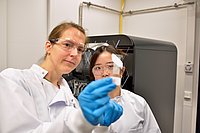
				   <img title="Group photo: Skopp, Sieber, and Marosevic in the lab with purified protein showing the color differences." alt="Group photo: Skopp, Sieber, and Marosevic in the lab with purified protein showing the color differences." src="https://www.tum.de/fileadmin/_processed_/2/f/csm_Lebende_Materialien_UV-A-Sensor-Sieber_47c15f50c4.jpg" width="200" height="113" />
            <a title="Living material makes harmful UV-light visible" href="https://www.tum.de/en/news-and-events/all-news/press-releases/details/living-material-makes-harmful-uv-light-visible">
             Living material makes harmful UV-light visible
            </a>
           <p>The protein mEosFP can blush: when exposed to UV-A light, it shifts from a green shade called “Vegan Villain” to a red known as “End of Summer.” Because of this pronounced color shift, the protein is a strong candidate for UV-A sensors that indicate when certain thresholds are reached. Until now, however, it remained unclear how to integrate such proteins into paints and coatings in a stable, functional way—without compromising material properties.
A team led by Volker Sieber, Professor of Chemistry of Biogenic Resources and Rector of the TUM Campus Straubing, has now engineered a solution to this problem. The result is a sustainable, bio-based alternative to conventional UV-A-sensors, which typically rely on fossil raw materials such as oil and coal. Their findings could serve as a blueprint for advances in the emerging field of so called living materials, which aim to combine the strengths of biology and technology. In these biohybrid materials, organisms such as fungi, algae, proteins, or bacteria are embedded in solid materials so that they can repair themselves, grow, or respond to environmental stimuli.</p>
         </div>
				</content>
			</entry>
		
			<entry>
				<id>https://www.tum.de/en/news-41127.atom</id>
				<title>Established cancer drug reactivates immunotherapy</title>
				<author>
					<name>Paul Hellmich</name>
					<email>paul.hellmich@tum.de</email>
				</author>
        <published>2026-02-11T11:05:00+01:00</published>
        <updated>2026-02-11T11:40:55+01:00</updated>
				<link rel="alternate" type="text/html" href="https://www.tum.de/en/news-and-events/all-news/press-releases/details/established-cancer-drug-reactivates-immunotherapy"/>
				<summary>Genetically modified immune cells can offer precious additional time to patients with advanced multiple myeloma. However, these therapies lose their impact as the molecules on cancer cells that immune cells recognize gradually vanish. Researchers at the Technical University of Munich (TUM) have now identified one of the molecular mechanisms behind this process. In an initial study they succeeded in blocking it using an existing cancer drug.</summary>
				<content type="xhtml">
				<div xmlns="http://www.w3.org/1999/xhtml">
				   <img title="Professor Florian Bassermann" alt="Professor Florian Bassermann" src="https://www.tum.de/fileadmin/_processed_/e/1/csm_250825_Bassermann_Florian_klein__1__5c66d369cb.jpg" width="200" height="113" />
            <a title="Established cancer drug reactivates immunotherapy" href="https://www.tum.de/en/news-and-events/all-news/press-releases/details/established-cancer-drug-reactivates-immunotherapy">
             Established cancer drug reactivates immunotherapy
            </a>
           <p>CAR T cell therapies are becoming increasingly important in cancer treatment. The approach involves modifying a patient’s own T cells in the lab. They are equipped with artificial receptors that “recognize” specific molecules on cancer cells. These engineered immune cells multiply in the body and destroy the malignant cells. In the case of multiple myeloma, the target molecule is BCMA – short for B Cell Maturation Antigen.
“BCMA is well suited as a target for CAR‑T therapy because it is highly specific to malignant plasma cells,&quot; explains Prof. Florian Bassermann, Director of the Department of Internal Medicine III at TUM University Hospital. “But cancer immunotherapy triggers rapid evolution inside the body.” The engineered T cells exert selective pressure, meaning that cancer cells that have little or no BCMA on their surface proliferate while others are destroyed. &amp;nbsp;As a result, the therapy gradually stops working. CAR T cell therapies are currently only used for multiple myeloma after other treatment options have failed. They can prolong life – sometimes by years – but have not yet been able to permanently eliminate the cancer.</p>
         </div>
				</content>
			</entry>
		
			<entry>
				<id>https://www.tum.de/en/news-41980.atom</id>
				<title>TUM establishes the TUM Security and Defense Alliance together with partners</title>
				<author>
					<name>Moritz Müller</name>
					
				</author>
        <published>2026-02-09T14:00:00+01:00</published>
        <updated>2026-02-09T14:33:53+01:00</updated>
				<link rel="alternate" type="text/html" href="https://www.tum.de/en/news-and-events/all-news/press-releases/details/tum-founds-the-tum-security-and-defense-alliance-with-partners"/>
				<summary>The Technical University of Munich (TUM) and the University of the Bundeswehr Munich (UniBw M) are sending a strong signal for European security and defense capabilities and technological sovereignty: Together with industrial partners, start-ups, the TUM Venture Labs and public sector stakeholders, the &quot;TUM Security and Defense Alliance&quot; was launched as a strategic, interdisciplinary innovation hub for security and defense technologies.</summary>
				<content type="xhtml">
				<div xmlns="http://www.w3.org/1999/xhtml">
				   <img title="TUM Security and Defence Alliance; Vertragsunterzeichnung; Foto: Andreas Heddergott /TUM; Verwendung frei für die Berichterstattung über die TUM bei Nennung des Copyrights /
Free for use in reporting on TUM, with the copyright noted" alt="Start der TUM Security and Defense Alliance - mittig v.l. TUM Präsident Thomas F. Hofmann, Bayerns Wissenschaftsminister Markus Blume, Prof. Eva-Maria Kern, Präsidentin der UniBw M" src="https://www.tum.de/fileadmin/_processed_/5/9/csm_20260209_Security_Defence_AH_969649_93778e857e.jpg" width="200" height="113" />
            <a title="TUM establishes the TUM Security and Defense Alliance together with partners" href="https://www.tum.de/en/news-and-events/all-news/press-releases/details/tum-founds-the-tum-security-and-defense-alliance-with-partners">
             TUM establishes the TUM Security and Defense Alliance together with partners
            </a>
           <p>Greater Munich is one of Europe’s key regions for research, innovation, development and industry in the security and defense sector. The goal of the alliance is to link and systematically strengthen the existing and emerging centers of excellence across this metropolitan area.
The partners of the TUM Security and Defense Alliance, alongside the Technical University of Munich and the University of the Bundeswehr Munich, are:
 	Airbus Defence and Space GmbH 	Diehl Defence GmbH &amp;amp; Co. KG 	Helsing Germany GmbH 	Hensoldt AG 	Industrieanlagen-Betriebsgesellschaft mbH 	Isar Aerospace SE 	MBDA Deutschland GmbH 	MTU Aero Engines AG 	Neuraspace 	Quantum-Systems GmbH 	Resaro Europe GmbH 	Rohde &amp;amp; Schwarz GmbH &amp;amp; Co. KG 	SAP SE 	TUM Venture Lab Aerospace / Defense 	TYTAN Technologies GmbH 
The alliance covers all relevant domains: air, space, land, sea, as well as the cyber and information space. In addition, it aims to reinforce Bavaria’s role as a leading high‑tech region and as a central pillar of European security, resilience and responsible international engagement.
Prof. Thomas F. Hofmann, President of TUM, said: &quot;If you want to secure peace, you have to be able to defend it. We stand by this statement and are creating an innovation ecosystem for more European security with the TUM Security and Defense Alliance. The Alliance aims to responsibly and efficiently transform cutting-edge research and marketable innovations into operational capabilities that contribute to deterrence, crisis prevention, stabilization and peacekeeping.&quot;
Prof. Eva-Maria Kern, President of UniBw M, said: &quot;As the University of the Bundeswehr Munich, we stand for proven expertise in security and defense research. Through the TUM Security and Defense Alliance, we can join forces with strong partners, pool key competencies and translate knowledge into real impact — for a free, secure and resilient Europe.&quot;
Bavaria&#039;s Science Minister Markus Blume said: &quot;TUM is stepping up its capabilities. With the Security and Defense Alliance, the Free State of Bavaria is becoming the technological command center for Europe’s security. In a forward‑looking alliance of the willing, all key players in the field of security are coming together here. More than ever, security depends on strong innovation ecosystems. The new alliance institutionalizes collaboration among the partners — from fundamental research to application and even to the creation of start-ups. This strengthens Bavaria’s position as a hub for security and defense technology and builds our own resilience. Deterrence cannot be achieved through lengthy debates about civil clauses. Our universities must address security‑relevant questions — dual‑use is a necessity of our time. In an era of hybrid high‑tech warfare, bold innovation is the decisive factor. The guiding principle is: High‑tech protects our homeland.&quot;
Prof. Chiara Manfletti, coordinator of the TUM Security and Defense Alliance, said: &quot;We already have an excellent network in the field of defense at TUM. With the newly founded alliance, we are creating a structure that brings the most important players together. This platform will provide the foundation for systematically strengthening research, development and implementation.&quot;</p>
         </div>
				</content>
			</entry>
		
			<entry>
				<id>https://www.tum.de/en/news-41970.atom</id>
				<title>“Those who want to secure peace must be able to defend it”</title>
				<author>
					<name>Ulrich Meyer</name>
					
				</author>
        <published>2026-02-09T13:59:00+01:00</published>
        <updated>2026-02-09T15:28:27+01:00</updated>
				<link rel="alternate" type="text/html" href="https://www.tum.de/en/news-and-events/all-news/press-releases/details/those-who-want-to-secure-peace-must-be-able-to-defend-it"/>
				<summary>The targeted disruption of the world order and the increasing erosion of the liberal democratic community of shared values are challenging Europe’s current security systems. In this interview, President Prof. Thomas F. Hofmann classifies the new challenges and situates the Technical University of Munich (TUM) within this important societal debate.</summary>
				<content type="xhtml">
				<div xmlns="http://www.w3.org/1999/xhtml">
				   <img src="https://www.tum.de/fileadmin/user_upload_87/_processed_/c/f/csm_Querformat_015515a3af.jpg" width="200" height="133" alt="" />
            <a title="“Those who want to secure peace must be able to defend it”" href="https://www.tum.de/en/news-and-events/all-news/press-releases/details/those-who-want-to-secure-peace-must-be-able-to-defend-it">
             “Those who want to secure peace must be able to defend it”
            </a>
           <p>President Hofmann, how would you assess the current situation?
I consider the situation to be serious, and strategic adjustments to the new reality to be urgently required. Energy from Russia, security from the United States, and digitalization increasingly from China: supported by the naïve assumption that things would simply continue as they were, we in Germany made ourselves comfortable for far too long. The relocation of system-critical economic sectors abroad, new geopolitical realities, intensifying competition between different systems of governance, and a dramatically changed security situation require a fundamental rethinking.&amp;nbsp;
At the latest, Russia’s war of aggression against Ukraine, in violation of international law, jolted us awake from our slumber and shattered the illusion of a positive normalcy. We are all watching with concern the resurgence and strengthening of authoritarian forms of rule worldwide and new imperialist attacks on international law. We are witnessing the targeted use of disinformation as well as the superiority of new technologies in hybrid warfare. All of this is driving global destabilization forward at breathtaking speed, confronting Germany with decisive economic, foreign-policy, and security-policy choices and requiring a long-overdue strengthening of the European security architecture.
What consequences does this have for the state, for industry – and especially for universities?
If Europe does not want to become a plaything of the “great powers,” it must strengthen its self-determination and its ability to defend itself – and it must do so quickly. This is not only a task for companies and policymakers, but very much for universities as well. It is crucial that their discoveries, inventions, and technological developments be fed more effectively into marketable innovation processes, that their economic potential be scaled within Europe, and that they be made usable for a modern, capable defense of our liberal democratic community of shared values. Universities that act responsibly do not evade this mandate.
Which areas are particularly relevant to defense capability?
Protecting our population and national security, in the face of increasingly hybrid threats and entirely new forms of warfare, above all requires technological progress. The development of AI-controlled, autonomous, and largely unmanned systems, electronic defense, the strengthening of our cybersecurity, and the creation of a European space infrastructure must be significantly accelerated. At the same time, we must advance the development of new materials and manufacturing processes, as well as the recovery of valuable raw materials, as part of a responsive and resilient logistics system, in order to be able to react quickly and cost-effectively to changing threats.
At many German universities, dual-use potential is still treated as taboo. Can you understand that?
No. In a naïve way, Germany has largely left the development of modern defense technologies to other countries – and unnecessarily limited itself to the Bundeswehr military universities. At the same time, outstanding technological innovations with dual-use potential are emerging at German universities, meaning they can be used for both civilian and military purposes. Their use for military purposes has so far been considered taboo in Germany – as if neutrality in security-critical matters were a moral value. In view of the high level of public investment in our universities and the dramatic geopolitical changes, we are called upon to assume greater responsibility and to protect our liberal democratic community of shared values. To do so, we must also use technologies with dual-use potential for defensive military purposes.
Numerous German universities have civil clauses that explicitly prohibit even research for defensive military purposes. What is your view on this?
Universities must stop hiding behind a misunderstood civil clause and evading their responsibility. Those who want to secure peace must also be able to defend it.
Supporters of civil clauses also invoke peace. How do you see that?
Of course, supporters of civil clauses have always invoked peace as well. But in my view, the high value of the constitutionally enshrined freedom of teaching and research is not compatible with restrictions imposed by civil clauses. It must be the decision of the individual researchers whether and to what extent they wish to apply their expertise to the defense of our country. From my perspective, university leadership and governing bodies are not entitled to impose such restrictions through civil clauses.
The neutrality simulated by civil clauses is, in the face of attacks on our democratic value system, not a moral superiority but a dangerous retreat from reality. A free society whose universities complacently see themselves as ivory towers and do not wish to serve the needs of the country will not remain free in the long run.
How is TUM addressing this responsibility in concrete terms?
At the Technical University of Munich, we have accepted this societal mandate and begun creating the conditions that allow research, teaching, and innovation in the field of security and defense technologies to flourish.
Which projects are central to this effort?
This naturally includes the strong expansion of our research in geodesy and aerospace at the new TUM Campus Ottobrunn-Taufkirchen, which is being vigorously advanced as part of the Bavarian State Government’s Hightech Agenda. From a technological perspective, civilian and defensive military use are hardly separable here anyway. The same applies to our Munich Institute for Robotics and Machine Intelligence (MIRMI), one of Europe’s leading robotics institutes. Here, we use our innovations in robotics and autonomous systems for society by supporting people in their everyday lives and at work. And we contribute to improving people’s safety and making the country capable of defense.
Which research fields could be of interest for defense?
In fields such as robotics, autonomous systems, artificial intelligence, quantum sensing and communication, materials science, engineering, and the natural sciences, there is enormous potential – and a willingness among leading minds to place their research in the service of safeguarding freedom, democracy, and peace. Even in medical research, possible scenarios for a defense situation are taken into account. For example, our trauma surgery department is working together with experts from the TUM Department of Aerospace and Geodesy and the company Avilus on the Grille transport drone, which is intended to quickly evacuate injured soldiers behind the lines.
At the same time, we are strengthening education for democracy in our student teaching, for example through the offerings of our Munich School of Politics and Public Policy and the TUM School of Social Sciences and Technology. We must enable our young people to stand up, out of inner conviction, for democracy, freedom, human rights, economic security, and peace. This is becoming increasingly important, as the democracy in which we live is being questioned more and more, including in our own country.
TUM is considered strong in cooperation with companies and external partners. How do you plan to further develop this?
The greater Munich area has everything needed to build an innovation ecosystem for security and defense technologies. We have just founded the TUM Security and Defense Alliance, thereby linking TUM’s scientific excellence with the practical expertise of the&amp;nbsp;University of the Bundeswehr Munich, industry, the scaling capabilities of established companies, and the agility and innovative strength of the TUM Venture Labs. Together, we aim to unlock synergies within an innovation ecosystem for security and defense technologies and become alliance-ready for strong European networking.</p>
         </div>
				</content>
			</entry>
		
			<entry>
				<id>https://www.tum.de/en/news-41959.atom</id>
				<title>AI in Biomedicine</title>
				<author>
					<name>Stefan Kögler</name>
					<email>stefan.koegler@tum.de</email>
				</author>
        <published>2026-02-06T11:31:00+01:00</published>
        <updated>2026-02-09T14:12:38+01:00</updated>
				<link rel="alternate" type="text/html" href="https://www.tum.de/en/news-and-events/all-news/press-releases/details/ai-in-biomedicine"/>
				<summary>More than a degree: Leibniz Prize winner Daniel Rückert talks about the potential of the new elite master&#039;s program at the intersection of artificial intelligence and biomedicine, the future of personalized medicine, and his personal expectations for the new program.</summary>
				<content type="xhtml">
				<div xmlns="http://www.w3.org/1999/xhtml">
				   <img title="Prof. Dr. Daniel Rückert" alt="Portrait photo of Prof. Dr. Daniel Rückert in a TUM building" src="https://www.tum.de/fileadmin/user_upload_87/_processed_/1/f/csm_20210824_Prof_Daniel_Rueckert_Juli-Eberle-1805_39c29c62a5.jpg" width="200" height="133" />
            <a title="AI in Biomedicine" href="https://www.tum.de/en/news-and-events/all-news/press-releases/details/ai-in-biomedicine">
             AI in Biomedicine
            </a>
           <p>Professor Rückert, what personally motivated you to initiate this new master’s program?
My daily work in research and teaching played a significant role in motivating me. In recent years, I have repeatedly seen how vast the potential of AI in biomedicine is - and at the same time how challenging it can be to find exceptionally well‑trained students who combine both methodological depth in AI and a genuine understanding of biomedical questions. High‑quality master’s theses and later doctoral research require precisely this combination.
With the master’s program AI in Biomedicine, we aim to create a structured framework that integrates competencies from computer science and biomedicine from the very beginning - at a high scientific level and in close connection to current research.
At the same time, it was a personal priority for me to create an environment where highly talented and motivated students can assume responsibility early on, learn to think independently, and work on real medical challenges. For me, AI in Biomedicine is therefore not only a degree program but also an investment in the next generation of researchers who will combine robust AI methodologies with biomedical expertise and carry these skills into research, clinical practice, or industry.</p>
         </div>
				</content>
			</entry>
		
			<entry>
				<id>https://www.tum.de/en/news-41969.atom</id>
				<title>Mobility research in the spotlight for children</title>
				<author>
					<name>-</name>
					
				</author>
        <published>2026-02-04T16:05:16+01:00</published>
        <updated>2026-02-05T13:48:11+01:00</updated>
				<link rel="alternate" type="text/html" href="https://www.tum.de/en/news-and-events/all-news/press-releases/details/mobility-research-in-the-spotlight-for-children"/>
				<summary>Two well-known children&#039;s TV Shows have brought mobility research at the Technical University of Munich (TUM) closer to a young audience - &quot;Checker Tobi&quot; and &quot;1, 2 oder 3&quot;.</summary>
				<content type="xhtml">
				<div xmlns="http://www.w3.org/1999/xhtml">
				   <img title="Dreh Checker Tobi MCube" alt="Kinder und Checker Tobi planten gemeinsam eine lebenswerte Stadt" src="https://www.tum.de/fileadmin/_processed_/3/0/csm_260205_Dreh_Checker_Tobi_MCube_028e82dcc5.jpg" width="200" height="113" />
            <a title="Mobility research in the spotlight for children" href="https://www.tum.de/en/news-and-events/all-news/press-releases/details/mobility-research-in-the-spotlight-for-children">
             Mobility research in the spotlight for children
            </a>
           <p>In the Bavarian Broadcasting show “Checker Tobi,” host Tobi Krell visited the team of the TUM mobility cluster MCube. Together with children, he explored what cities could look like if we rethink mobility. MCube Managing Director Oliver May-Beckmann explains how cities could be made more livable&amp;nbsp;and how to create more space for people on foot and on bicycles – and especially for children playing.
The ZDF show&amp;nbsp;&quot;1, 2 oder 3&quot; also focused on current developments in mobility&amp;nbsp;–&amp;nbsp;with the direct involvement of TUM. Under the motto &quot;on the road by bus and train&quot;, MCube showed child-friendly examples of autonomous mobility: these included the autonomous TUM rickshaw prototype, the EDGAR research vehicle, and an insight into the opportunities and limitations of autonomous driving.
Both programs are now available in the ARD, ZDF and KiKa media libraries:
 	Checker Tobi - The Road Traffic Check (available until 24.01.2031) 	https://www.ardmediathek.de/video/checker-reportagen/der-strassenverkehrs-check/br/Y3JpZDovL2JyLmRlL2Jyb2FkY2FzdC84M2YyY2E3NS1jMjQ5LTQ4MjEtOTA1Yi05YjY3MGNhMmJhMzFfb25saW5lYnJvYWRjYXN0 	1, 2 oder&amp;nbsp;3 - On the road by bus and train 	https://www.zdf.de/video/shows/1-2-oder-3-120/unterwegs-mit-bus-und-bahn-100 </p>
         </div>
				</content>
			</entry>
		
			<entry>
				<id>https://www.tum.de/en/news-41967.atom</id>
				<title>First university-designed 7-nanometer AI chip</title>
				<author>
					<name>Andreas Schmitz</name>
					
				</author>
        <published>2026-02-04T09:00:00+01:00</published>
        <updated>2026-02-04T13:55:05+01:00</updated>
				<link rel="alternate" type="text/html" href="https://www.tum.de/en/news-and-events/all-news/press-releases/details/first-university-designed-7-nanometer-ai-chip"/>
				<summary>The Technical University of Munich (TUM) has unveiled the EU&#039;s first AI chip using modern 7-nanometer technology. The neuromorphic chip was designed by Prof. Hussam Amrouch in accordance with the industry standards set by world-leading chip manufacturer TSMC. The professor of AI processor design and his research group now plan to produce at least three new designs per year, to be manufactured from 2028 onward by the Dresden-based European Semiconductor Manufacturing Company (ESMC). </summary>
				<content type="xhtml">
				<div xmlns="http://www.w3.org/1999/xhtml">
				   <img src="https://www.tum.de/fileadmin/_processed_/0/4/csm_Aufmacher_20250512_Prof_Amrouch_AH_902350_5b6e9a7025.jpg" width="200" height="133" alt="" />
            <a title="First university-designed 7-nanometer AI chip" href="https://www.tum.de/en/news-and-events/all-news/press-releases/details/first-university-designed-7-nanometer-ai-chip">
             First university-designed 7-nanometer AI chip
            </a>
           <p>The COVID-19 pandemic, the war in Ukraine and broader geopolitical shifts have exposed weaknesses in global supply chains. ‘That is why it will be crucial in the future to cover all stages in Germany and Europe — from training AI chip specialists to technological development and chip manufacturing,’ says Prof. Amrouch. Earlier this year he established the MACHT-AI chip research and training center at TUM, funded by the Bavarian Ministries of Science and Economic Affairs. Looking ahead, he envisions students in Germany learning to design AI chips and develop algorithms directly with companies, with production also taking place domestically.&amp;nbsp;&amp;nbsp;&amp;nbsp;
AI chip enables local data processing
In contrast to cloud-based chips such as those manufactured by NVIDIA, Prof. Amrouch’s approach focuses on technology that processes data locally on the device itself rather than sending it to the cloud. ‘This is a fundamental solution for protecting the privacy of our citizens,’ says Amrouch.
The AI chips are based on the open-source RISC-V architecture and can be customized for specific applications — from recording and analyzing heartbeats or brain signals in healthcare to implementing language models. This specialization is more efficient than using a general-purpose AI chip. Amrouch: ‘You can buy a Ferrari, but that doesn&#039;t necessarily make you faster in the city. An e-bike is more efficient here.’ Another critical point is that the technology is also intended for use in control electronics in quantum computing in the medium term.
Data remains private and secure
Local data processing enhances cybersecurity and helps protect technologies against misuse by third parties. ‘Those who design and build the chip know exactly what is inside it and can guarantee how it will function,’ says Amrouch, who believes it is essential for companies to be able to assure their customers that their data will remain private.
Trust is a critical ‘currency’ for industries such as the automotive sector, where Europe currently lacks sovereignty in high-performance chips. The defense industry also places the most stringent demands on security, for example when it comes to the use of chips for drones. Potential built-in vulnerabilities such as Trojans pose incalculable risks here, especially if chips are developed and manufactured outside Germany and the EU.
Markus Blume, Bavaria’s Minister of Science, said: “This is a big breakthrough for AI research at TUM. The European Union’s first AI chip using 7-nanometre technology comes from Bavaria and combines performance, energy efficiency and security. With MACHT-AI, TUM plays a central role in Bavaria’s semiconductor ecosystem. To remain competitive and independent while retaining technological sovereignty, we are developing key technologies and training talent here.”
Bavarian Minister of Economic Affairs Hubert Aiwanger is convinced: ‘Artificial intelligence has undergone tremendous development in recent years. As an economy, we must be in a position not only to keep pace with this development, but also to help shape it. The development of TUM&#039;s own AI chip is an impressive demonstration of how well the Bavarian semiconductor ecosystem is developing.’
TUM President Thomas Hofmann emphasizes: &quot;Geopolitical risks have increased dramatically in recent years. That is why cutting-edge technology must be developed and produced in Germany and Europe. With his AI chips, Prof. Hussam Amrouch impressively demonstrates how dependence on Asia and the USA can be successfully reduced, and Europe&#039;s technological self-determination strengthened. And, incidentally, with a very sustainable concept.&quot;</p>
         </div>
				</content>
			</entry>
		
			<entry>
				<id>https://www.tum.de/en/news-41950.atom</id>
				<title>Probiotics for Plants</title>
				<author>
					<name>Linda Schinnenburg</name>
					
				</author>
        <published>2026-02-03T11:00:00+01:00</published>
        <updated>2026-02-03T11:48:35+01:00</updated>
				<link rel="alternate" type="text/html" href="https://www.tum.de/en/news-and-events/all-news/press-releases/details/probiotics-for-plants"/>
				<summary>Researchers at the Technical University of Munich (TUM) have identified a bacterial genus that promotes root growth and nitrogen uptake in plants. The findings open new possibilities for developing customized “plant probiotics” that could contribute to more resource-efficient agriculture by reducing the need for nitrogen fertilizer.</summary>
				<content type="xhtml">
				<div xmlns="http://www.w3.org/1999/xhtml">
				   <img title="Probiotics for Plants" alt="Es sind gelb blühende Rapspflanzen auf einem Feld zu sehen. Im Hintergrund sind einzelne Bäume zu erkennen." src="https://www.tum.de/fileadmin/_processed_/a/b/csm_260203_Flowering_Rapeseed_Probiotics_for_Plants_Yu_01_7ed745ef0c.jpg" width="200" height="113" />
            <a title="Probiotics for Plants" href="https://www.tum.de/en/news-and-events/all-news/press-releases/details/probiotics-for-plants">
             Probiotics for Plants
            </a>
           <p></p>
         </div>
				</content>
			</entry>
		
			<entry>
				<id>https://www.tum.de/en/news-41952.atom</id>
				<title>TUM launches Center for Alpine Forest Management</title>
				<author>
					<name>Anja Lapac</name>
					
				</author>
        <published>2026-02-02T15:56:00+01:00</published>
        <updated>2026-02-02T09:19:07+01:00</updated>
				<link rel="alternate" type="text/html" href="https://www.tum.de/en/news-and-events/all-news/press-releases/details/tum-launches-center-for-alpine-forest-management"/>
				<summary>Sixty percent of Bavaria’s alpine forests serve as protective forests that safeguard settlements and infrastructure from the impacts of extreme weather events. Climate change is putting these forests under increasing pressure. To advance research, the Eva Mayr-Stihl Foundation supports TUM’s new Center for Alpine Forest Management, which examines these impacts and evaluates long-term options to sustain protective forests.</summary>
				<content type="xhtml">
				<div xmlns="http://www.w3.org/1999/xhtml">
				   <img title="View of Lake Königssee in Bavaria, set in the winter mountains with snow-covered trees." alt="View of Lake Königssee in Bavaria, set in the winter mountains with snow-covered trees." src="https://www.tum.de/fileadmin/_processed_/8/4/csm_Zentrum_fuer_Alpine_Waldwirtschaft_an_der_TUM_632ce33457.jpg" width="200" height="133" />
            <a title="TUM launches Center for Alpine Forest Management" href="https://www.tum.de/en/news-and-events/all-news/press-releases/details/tum-launches-center-for-alpine-forest-management">
             TUM launches Center for Alpine Forest Management
            </a>
           <p>Retreating glaciers, rising snow lines, and increasing rockfall already show how climate change is reshaping mountain regions - and alpine forests are no exception. These forests are particularly vulnerable, as warming in the Alps is twice the global average, placing significant stress on forest ecosystems. This also affects protective forests, which reduce natural hazard risks for nearby communities and therefore require specialized management and upkeep.
It remains uncertain whether and to what extent alpine protective forests will continue to fulfill this role in the future. At the same time, the likelihood of avalanches, debris flows, and rockfall is increasing- the very hazards these forests help moderate. Over the next four and a half years, the Center for Alpine Forest Management, supported by the Eva Mayr-Stihl Foundation, will study how these developments are shaping alpine forests and how this transformation can be actively managed.
Robert Mayr, founder and chairman of the Eva Mayr-Stihl Foundation, explains the motivation behind the initiative: “I spent most of my childhood in Upper Bavaria outdoors in nature. Even later, my vacations revolved around hiking and skiing. I view the changes driven by climate change, particularly in mountain forests, with deep concern.”</p>
         </div>
				</content>
			</entry>
		
			<entry>
				<id>https://www.tum.de/en/news-41949.atom</id>
				<title>&quot;Obesity originates in the brain&quot;</title>
				<author>
					<name>Undine Ziller</name>
					<email>undine.ziller@tum.de</email>
				</author>
        <published>2026-01-29T14:05:41+01:00</published>
        <updated>2026-01-30T14:30:35+01:00</updated>
				<link rel="alternate" type="text/html" href="https://www.tum.de/en/news-and-events/all-news/press-releases/details/obesity-originates-in-the-brain"/>
				<summary>Katharina Timper investigates the neurobiological mechanisms of overweight and obesity. As an endocrinologist and Professor of Clinical Nutritional Medicine, she is committed to advancing a holistic understanding and treatment of this widespread disease. In a recent episode of NewIn, she also discusses her efforts to counteract the stigma experienced by those affected.</summary>
				<content type="xhtml">
				<div xmlns="http://www.w3.org/1999/xhtml">
				   <img title="Prof. Katharina Timper" alt="Prof. Katharina Timper" src="https://www.tum.de/fileadmin/_processed_/5/0/csm_Timper_final_3f5868e81e.jpg" width="200" height="112" />
            <a title="&quot;Obesity originates in the brain&quot;" href="https://www.tum.de/en/news-and-events/all-news/press-releases/details/obesity-originates-in-the-brain">
             &quot;Obesity originates in the brain&quot;
            </a>
           <p></p>
         </div>
				</content>
			</entry>
		
			<entry>
				<id>https://www.tum.de/en/news-41934.atom</id>
				<title>TUM Researchers receive two ERC Grants</title>
				<author>
					<name>Paul Hellmich / Anja Lapac</name>
					<email>paul.hellmich@tum.de</email>
				</author>
        <published>2026-01-27T12:00:00+01:00</published>
        <updated>2026-01-27T12:54:59+01:00</updated>
				<link rel="alternate" type="text/html" href="https://www.tum.de/en/news-and-events/all-news/press-releases/details/two-erc-grants-for-tum-researchers"/>
				<summary>The European Research Council’s (ERC) Proof of Concept Grants are designed to help researchers turn their findings into real‑world innovations. Two ERC‑funded follow‑up projects at TUM will each receive approximately 150,000 euros in support. The projects focus on virus‑driven cancer treatments and new ways to supply electrons for enzyme‑based technologies.
</summary>
				<content type="xhtml">
				<div xmlns="http://www.w3.org/1999/xhtml">
				   <img title="PD Dr. Jennifer Altomonte" alt="PD Dr. Jennifer Altomonte" src="https://www.tum.de/fileadmin/_processed_/8/0/csm_260127_20200616_Prof_Altomonte-0436_d16c3e01d3.jpg" width="200" height="112" />
            <a title="TUM Researchers receive two ERC Grants" href="https://www.tum.de/en/news-and-events/all-news/press-releases/details/two-erc-grants-for-tum-researchers">
             TUM Researchers receive two ERC Grants
            </a>
           <p>Researchers at TUM have secured a total of 263 ERC grants to date. These are awarded each year in different categories. ERC Proof of Concept Grants support researchers in exploring whether their ERC‑funded work can be developed into viable commercial applications.</p>
         </div>
				</content>
			</entry>
		
			<entry>
				<id>https://www.tum.de/en/news-41942.atom</id>
				<title>Majority in favor of cutting social spending in favor of defense</title>
				<author>
					<name>Klaus Becker</name>
					<email>klaus.becker@tum.de</email>
				</author>
        <published>2026-01-27T11:00:00+01:00</published>
        <updated>2026-01-27T11:13:33+01:00</updated>
				<link rel="alternate" type="text/html" href="https://www.tum.de/en/news-and-events/all-news/press-releases/details/majority-in-favor-of-cutting-social-spending-in-favor-of-defense"/>
				<summary>Most Germans fear a military conflict between Russia and a NATO member state and are in favor of increasing the size of the German armed forces and creating a European army. To this end, a majority want to increase defense spending and reduce social spending. This is shown by a survey conducted by the Technical University of Munich (TUM) and the Leipzig University.</summary>
				<content type="xhtml">
				<div xmlns="http://www.w3.org/1999/xhtml">
				   <img title="Most Germans fear a military conflict between Russia and a NATO member." alt="NATO headquarter" src="https://www.tum.de/fileadmin/_processed_/e/3/csm_260127_Verteidigungspolitik_fa0c2920d1.jpg" width="200" height="112" />
            <a title="Majority in favor of cutting social spending in favor of defense" href="https://www.tum.de/en/news-and-events/all-news/press-releases/details/majority-in-favor-of-cutting-social-spending-in-favor-of-defense">
             Majority in favor of cutting social spending in favor of defense
            </a>
           <p>A large majority of Germans (70%) consider their country&#039;s defense capabilities to be important. Nearly two-thirds (62%) of those surveyed fear a military conflict between Russia and a NATO member state. Nearly half (42%) are very concerned that such a conflict between Germany and Russia could occur on German territory.
Therefore, the research team asked about specific security policy measures. The measures that received the most support were increasing the size of the German armed forces (60%), stronger government intervention against hybrid attacks by Russia (58%) and a joint European army (55%). Relative majorities support the reintroduction of compulsory military service (49% in favor, 27% opposed) and compulsory community service, for example in civil protection (48% in favor, 21% opposed). However, there is no majority in favor of increasing military aid to Ukraine (27% in favor, 41% opposed). Around two-thirds (67%) would like to see closer cooperation between EU countries on defense and security policy.
“Overall, the results reflect a clear public appetite for reform aimed at strengthening Germany’s defense capability and offer insights into which defense policies are likely to command majority support,” says co-study head Prof. Sebastian Blesse from the Leipzig University.</p>
         </div>
				</content>
			</entry>
		
			<entry>
				<id>https://www.tum.de/en/news-41932.atom</id>
				<title>Making the chemical industry more sustainable</title>
				<author>
					<name>Ulrich Meyer</name>
					
				</author>
        <published>2026-01-23T08:48:47+01:00</published>
        <updated>2026-01-30T15:17:28+01:00</updated>
				<link rel="alternate" type="text/html" href="https://www.tum.de/en/news-and-events/all-news/press-releases/details/making-the-chemical-industry-more-sustainable"/>
				<summary>The start-up SYPOX has set itself an ambitious goal: it wants to make the chemical industry more sustainable. Instead of burning oil and gas, the heat required for a wide range of chemical processes is generated electrically. The founders met at the Technical University of Munich (TUM) and jointly developed the required technology. The company has already secured its first major customer.</summary>
				<content type="xhtml">
				<div xmlns="http://www.w3.org/1999/xhtml">
				   <img src="https://www.tum.de/fileadmin/user_upload_87/_processed_/4/2/csm_SYPOX_6_dcf41023d3.jpg" width="200" height="150" alt="" />
            <a title="Making the chemical industry more sustainable" href="https://www.tum.de/en/news-and-events/all-news/press-releases/details/making-the-chemical-industry-more-sustainable">
             Making the chemical industry more sustainable
            </a>
           <p>Technology-based companies usually have one thing in common: they need a lot of capital for investment and development. This naturally goes hand in hand with time and pressure to succeed, because venture capitalists want to see results and have a say. SYPOX has taken a different path. “It was not our style to raise money, but we tried to build a business with our technology from the very beginning,” says CEO Dr. Gianluca Pauletto. This approach is unusual in the tech start-up scene, but it fits with the company&#039;s philosophy: down-to-earth, close to customer needs, focused on sustainable value creation.</p>
         </div>
				</content>
			</entry>
		
			<entry>
				<id>https://www.tum.de/en/news-41926.atom</id>
				<title>TUM and Tsinghua Expand Flagship Partnership</title>
				<author>
					<name>Marina Schreier und Ulrich Meyer</name>
					
				</author>
        <published>2026-01-22T09:27:52+01:00</published>
        <updated>2026-01-22T10:43:44+01:00</updated>
				<link rel="alternate" type="text/html" href="https://www.tum.de/en/news-and-events/all-news/press-releases/details/tum-and-tsinghua-expand-flagship-partnership"/>
				<summary>The Technical University of Munich (TUM) and Tsinghua University in China have renewed their flagship partnership and are expanding their long-standing strategic collaboration. The agreement provides the institutional framework for deepening cooperation in research, education, and innovation, and underscores the role of both universities as global actors in science and technology.</summary>
				<content type="xhtml">
				<div xmlns="http://www.w3.org/1999/xhtml">
				   <img src="https://www.tum.de/fileadmin/user_upload_87/_processed_/d/6/csm_20260121_MoU_Tsinghua_University_AH_965006_2eefc67238.jpg" width="200" height="133" alt="" />
            <a title="TUM and Tsinghua Expand Flagship Partnership" href="https://www.tum.de/en/news-and-events/all-news/press-releases/details/tum-and-tsinghua-expand-flagship-partnership">
             TUM and Tsinghua Expand Flagship Partnership
            </a>
           <p>The two leading universities from Germany and China aim to further develop their collaboration into a global ecosystem for transformation and knowledge exchange. The expansion of the partnership was formally sealed during a high-level delegation visit to Munich and Garching, led by Tsinghua President Prof. Luming Li. In addition to the ceremonial signing, discussions focused on future strategic direction and the further development of joint initiatives.</p>
         </div>
				</content>
			</entry>
		
			<entry>
				<id>https://www.tum.de/en/news-41919.atom</id>
				<title>Researchers present new Garmi</title>
				<author>
					<name>Andreas Schmitz</name>
					
				</author>
        <published>2026-01-22T08:15:18+01:00</published>
        <updated>2026-01-26T08:57:20+01:00</updated>
				<link rel="alternate" type="text/html" href="https://www.tum.de/en/news-and-events/all-news/press-releases/details/researchers-present-new-garmi"/>
				<summary>The Technical University of Munich (TUM) has developed a new robotic assistant. Robotics researchers from the Munich Institute of Robotics and Machine Intelligence (MIRMI) and designers from the Munich Design Institute (MDI) collaborated closely on this project. The research team presented the new robot to the public on the occasion of a visit to the Garmisch Research Centre by Judith Gerlach, Minister of State for Health, Care and Prevention.</summary>
				<content type="xhtml">
				<div xmlns="http://www.w3.org/1999/xhtml">
				   <img title="Forschende der Technischen Universität München testen den neuen Assistenzroboter im Labor in Garmisch." src="https://www.tum.de/fileadmin/_processed_/8/d/csm____260121_TUM_MIRMI_0093_MAX4303_foto_max_merget_5af6f7e5d1.jpg" width="200" height="113" alt="" />
            <a title="Researchers present new Garmi" href="https://www.tum.de/en/news-and-events/all-news/press-releases/details/researchers-present-new-garmi">
             Researchers present new Garmi
            </a>
           <p>The Garmi has evolved: on a stable, mobile base, the upper body of the new care-assist robot is attached to an extendable lifting column with arms located on the right and left-hand sides of the column. Above the arms is a head with alert eyes that blink from time to time. The new generation of Garmi has various sensors: cameras are mounted at eye level to detect movements in the environment, a lidar at leg height keeps objects in the immediate vicinity at a sufficient distance, and in future, 3D cameras will secure and coordinate the movements of the two arms. There is also a screen at chest height.
Robotics researchers: integrators of technology and design
‘The new Garmi understands language, develops a plan independently and brings a patient something to drink,’ says Alexander König, whose team developed and implemented the new platform. Based on the new design, the first forward-looking functionalities have now been developed. The MIRMI professor says: &quot;A robot must be functional and operable, but must also have an appealing appearance. That&#039;s why we are collaborating with design experts.&quot; Robotics engineer König sees his Garmi research team as an integrator that brings technology and design together. This includes, for example, precise grasping functionality (perception) and the ability to arrive at the exact location where a task is to be performed (navigation). The design should also support people in interacting and communicating with the robot while conveying trust and safety.</p>
         </div>
				</content>
			</entry>
		
			<entry>
				<id>https://www.tum.de/en/news-41915.atom</id>
				<title>TUM in the top 20 in three subject areas</title>
				<author>
					<name>Klaus Becker</name>
					<email>klaus.becker@tum.de</email>
				</author>
        <published>2026-01-21T06:39:00+01:00</published>
        <updated>2026-01-21T10:22:41+01:00</updated>
				<link rel="alternate" type="text/html" href="https://www.tum.de/en/news-and-events/all-news/press-releases/details/tum-in-the-top-20-in-three-subject-areas"/>
				<summary>TUM is one of the world&#039;s top 20 universities in computer sciences, natural sciences and engineering. This is shown by the latest subject rankings published by the British magazine Times Higher Education (THE).
</summary>
				<content type="xhtml">
				<div xmlns="http://www.w3.org/1999/xhtml">
				   <img title="Interdisciplinary robotics is one of TUM's main areas of research. " alt="Researchers in one of TUM's robotics labs" src="https://www.tum.de/fileadmin/_processed_/0/e/csm_260121_THE_Subject_Ranking_f859e30757.jpg" width="200" height="112" />
            <a title="TUM in the top 20 in three subject areas" href="https://www.tum.de/en/news-and-events/all-news/press-releases/details/tum-in-the-top-20-in-three-subject-areas">
             TUM in the top 20 in three subject areas
            </a>
           <p>In the THE World University Rankings by Subject, TUM achieved the following positions:
 	Computer Science: 15 	(1st in Germany) 	Physical Sciences: 19 	(1st in Germany) 	includes chemistry, physics, mathematics and environmental sciences, among others 	Engineering: 19 	(1st in Germany) 	Business and Economics: 29 	(1st in Germany) 	Education Studies: 31 	(1st in Germany) 	Life Sciences: 35 	(1st in Germany) 	Medical and Health: 54 	(4th in Germany) 	Social Sciences: 80 	(5th in Germany) 
The THE rankings take various factors into account: on the one hand, academics worldwide are asked about the reputation of universities in research and teaching. On the other hand, data such as the number of publications per researcher, citations per publication, the ratio of teaching staff to students, third-party funding raised from industry, the number of patents and the degree of internationalization are evaluated. These indicators are weighted according to the prevailing culture in the various subject areas. In the recently published main edition of the THE World University Rankings, TUM is ranked 27th.
TUM also ranks among the top 20 in the QS World University Rankings by Subject in natural sciences (18th place) and engineering (19th place). In the Shanghai Rankings, which examine more narrowly defined subjects, it belongs to the best 20 universities three times and to the top 50 six more times.</p>
         </div>
				</content>
			</entry>
		
	
</feed>