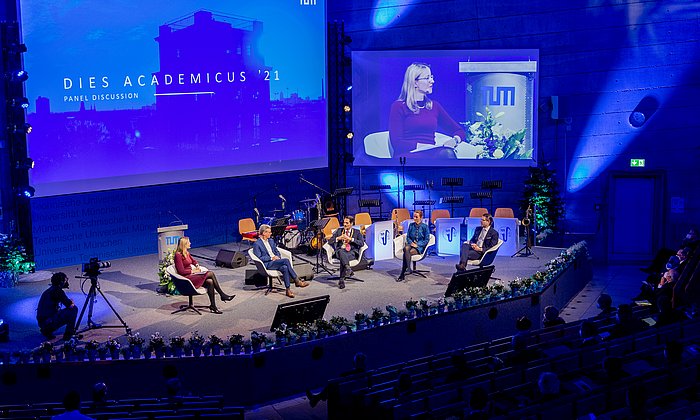
TUM Annual Celebration 2025 – Dies Academicus
Maintaining Excellence and Relevance

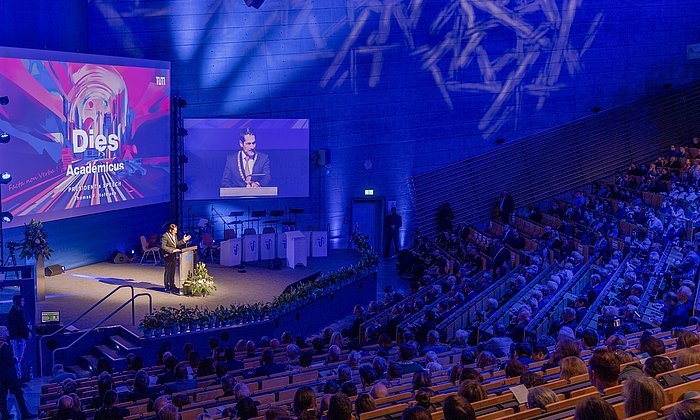
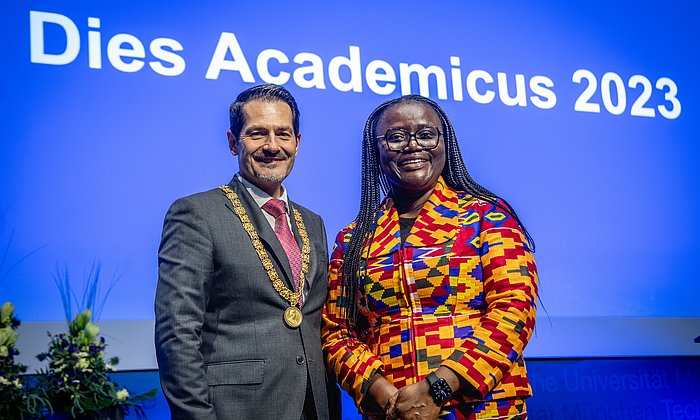
In his speech, President Hofmann emphasized: “With a clear vision for the future, we are facing the great challenges of our time in order to maintain excellence and relevance.” The world is confronted with technological advances at an unprecedented speed, structural economic changes, completely changed requirements for future workers, a progressive erosion of trust within society, and new geopolitical realities.

“The new TUM AGENDA 2030+ is therefore based on four strategic areas: We promote talent in all its diversity. We focus on responsible research and innovation. We strengthen our effectiveness for the benefit of humanity. And we strive for operational excellence,” emphasized the president, also referring to TUM's responsibility to society as a whole: “We will support our democracy wherever we can.”
Thanks to the great personal commitment of everyone at TUM, the steep upward trend of recent years has continued in 2025. For example, further ERC grants were again awarded in highly competitive procedures. Third-party funding has increased by 288 percent since 2006, and the number of applications to study has risen by 28 percent since 2019. The third pillar of TUM, alongside research and teaching, the promotion of start-ups, also continues to progress successfully. Every year, up to 100 young companies are founded from Europe's leading ecosystem with UnternehmerTUM and TUM Venture Labs.

Praise from the state government
Bavaria's Minister of Science Markus Blume praised the university's successes: "TUM is the blue chip among universities: strong substance and rising value! The best university in the EU offers excellence in all dimensions and disciplines. Seven clusters of excellence are a really strong statement. TUM shines throughout the world with its quality and its special TUM spirit – it is an international brand."
Paula Drobinski spoke at the Dies Academicus as a representative of the students. She emphasized: “Teaching has the same value as research.” The aim is to inspire enthusiasm among students and promote critical thinking and a sense of responsibility for society. “Excellence is an attitude that unites us all at TUM,” said Drobinski, who is a member of the TUM Senate. At the same time, she cautioned that not all lecture halls and laboratories at TUM live up to this standard.
TUM locations and services
In addition to its headquarters in Munich and the large research campus in Garching, TUM has four other central locations, which were presented at Dies Academicus:
- Heilbronn Campus – Under the motto “for the digital age,” research focuses on supporting small and medium-sized businesses. The TUM School of Management and the TUM School of Computation, Information, and Technology serve around 1,500 students. The director is Vice President Prof. Ali Sunyaev.
- Ottobrunn Campus – TUM's newest location is home to the aerospace and geodesy departments. Since this semester, bachelor's degree programs have been held in newly constructed buildings, which were completed in record time and can accommodate up to 2,500 students. The director is Prof. Chiara Manfletti, who is also chair of the TUM Senate.
- Straubing Campus – The TUM Campus for Biotechnology and Sustainability is dedicated to transforming the economy and society toward greater sustainability. Around 1,000 students acquire skills for implementing the bioeconomy here. The location is headed by Rector Prof. Volker Sieber.
- Singapore Campus (TUM Asia) – Around 10,000 kilometers away, the location, founded in 2002, addresses the challenges of the world's growing megacities, such as mobility and food supply. Around 1,000 students are enrolled. It is headed by Vice President Dr. Markus Wächter.
- TUM Real Estate Management – This central unit also presented its work. Department head Florian Loibl and his team manage around 500 university buildings and ensure that “we still have a physical roof over our heads in a digital world.” However, performance depends crucially on reliable government funding for necessary construction projects.
Awards
As is tradition, outstanding members of the university community were honored at the Dies Academicus.
The five founders of Reverion, a company that emerged from the TUM ecosystem, were honored as Entrepreneurs of Excellence: Dr. Stephan Herrmann, Felix Fischer, Maximilian Hauck, Luis Poblotzki, and Jeremias Weinrich. Their company has developed a highly efficient power plant that not only generates electricity from biogas, but can also produce hydrogen from surplus energy. Executive Vice President Prof. Claudia Peus praised the team as “a strong role model for the founders of the future.”
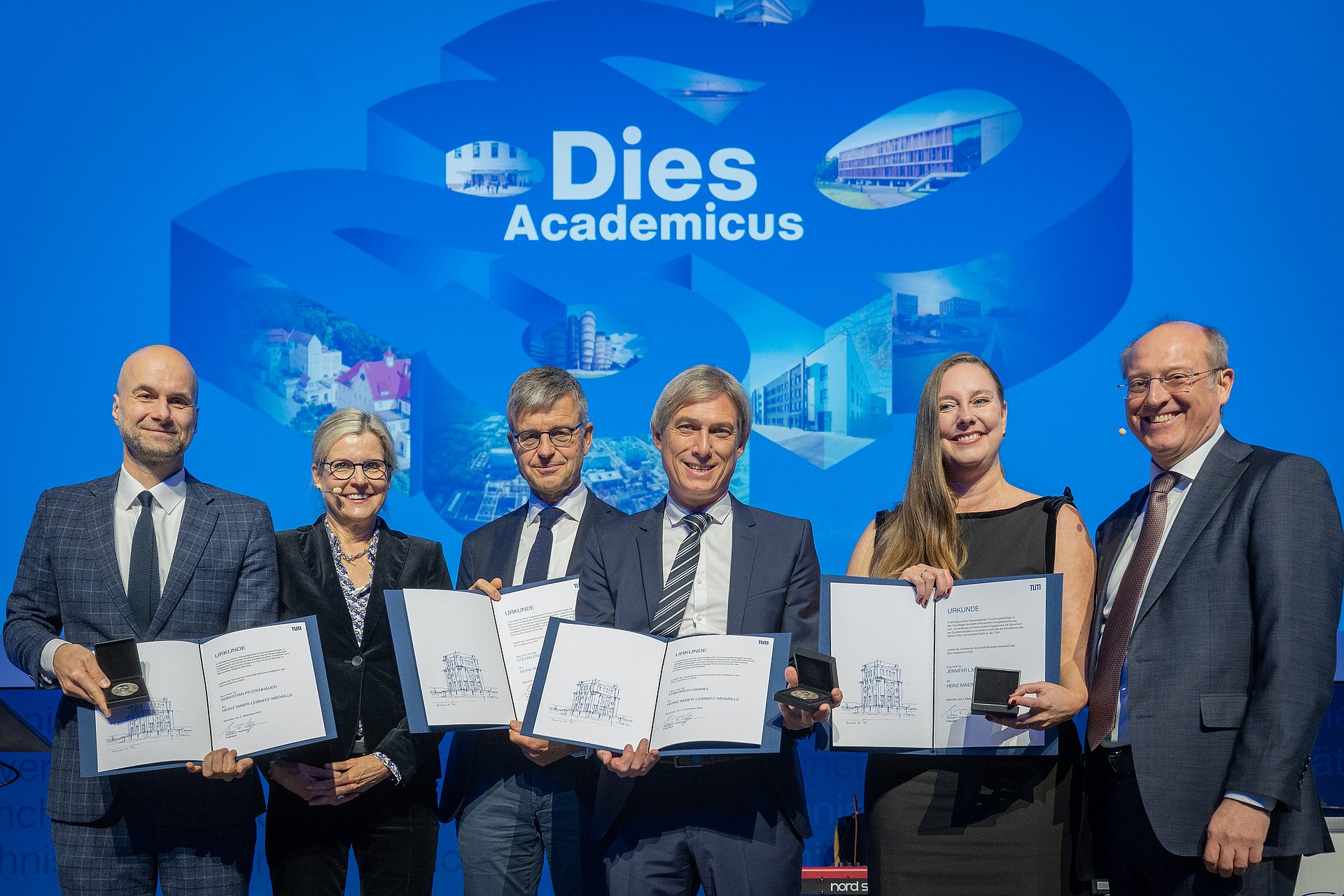
The university's highest scientific award, the Heinz Maier-Leibnitz Medal, went to four outstanding researchers and was presented by Executive Vice Presidents Prof. Juliane Winkelmann and Prof. Gerhard Kramer:
- Prof. Stefan Engelhardt – His research impressively demonstrates how fundamental biological mechanisms can lead to new, highly effective therapies. He works on nucleic acids and develops therapies for cardiovascular and pulmonary diseases. He is also the spokesperson for the new NUCLEATE Cluster of Excellence.
- Prof. Friedrich Simmel – As a pioneer in synthetic biosystems, he researches DNA-based nanostructures, artificial molecular machines, and biochemical control loops – work that opens up completely new perspectives on biological functionality. He is the spokesperson for the new BioSysteM Cluster of Excellence.
- Prof. Sebastian Pfotenhauer – is an internationally renowned expert in science and technology studies and innovation policy. He investigates the interplay between science, technology, and society and develops concepts for responsible innovation. He is the spokesperson for the TransforM Cluster of Excellence.
- Prof. Jennifer Rupp – is a world-leading expert in solid-state electrolytes and electrochemical energy storage. Her research is paving the way for novel chemical systems that could revolutionize batteries for electric vehicles and mobile electronics. She is spokesperson for the extended e-conversion Cluster of Excellence.
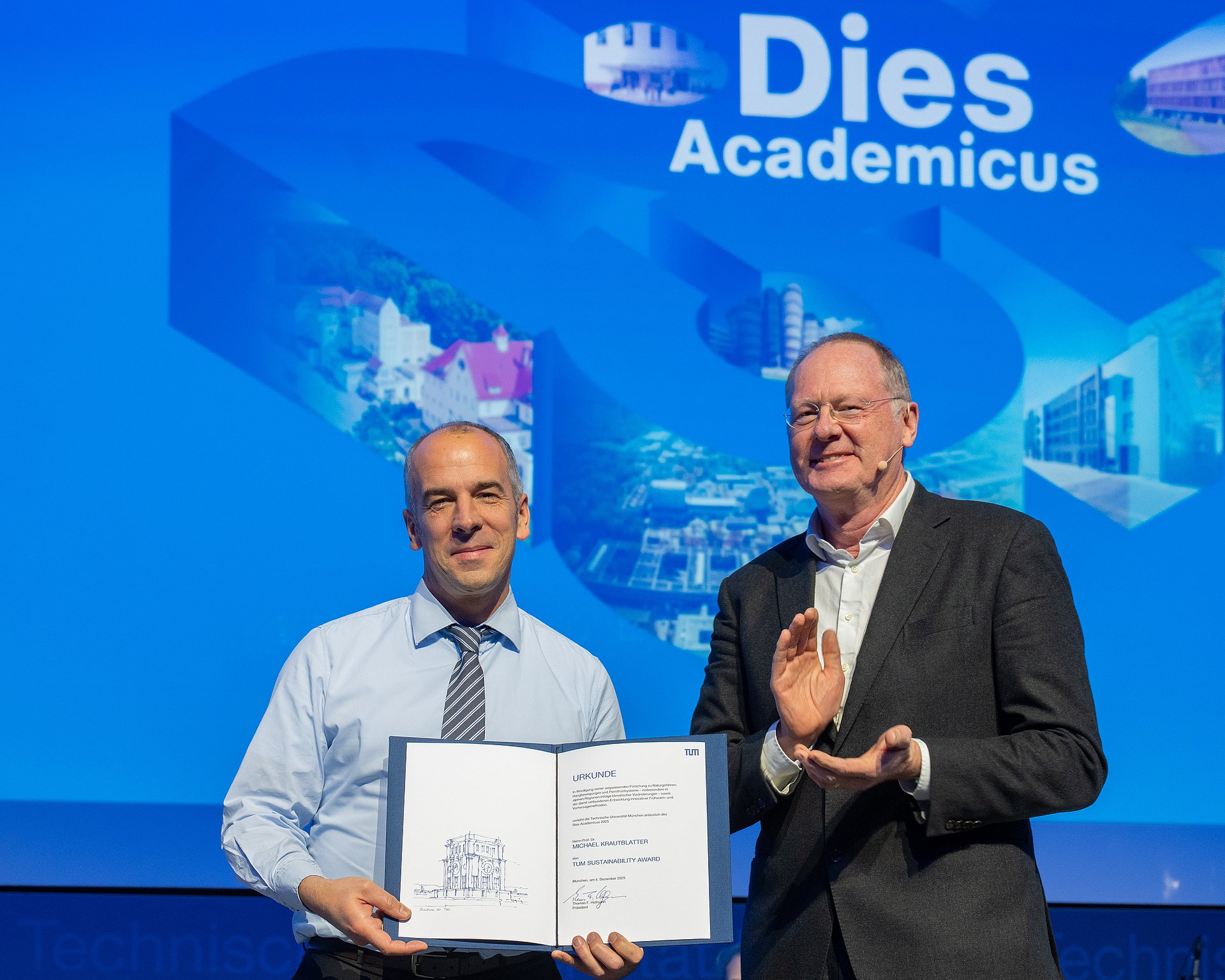
The TUM Sustainability Award goes to Prof. Michael Krautblatter. As an expert on natural hazards, slope movements, and permafrost – especially in alpine regions – he makes an important contribution to overcoming the challenges of climate change and securing a sustainable future. The award, presented by Vice President Prof. Werner Lang, is sponsored by the Johannes B. Ortner Foundation with 10,000 euros and recognizes innovative research that provides key impetus for the ecological transformation of the economy and society.
Technical University of Munich
Corporate Communications Center
- Ulrich Meyer
- presse@tum.de
- Teamwebsite
![[Translate to English:] Präsident Thomas F. Hofmann beim Dies Academicus 2022.](/fileadmin/user_upload/20221201_Dies_Academicus_AE_-298.jpg "[Translate to English:] Präsident Thomas F. Hofmann beim Dies Academicus 2022.")