University of Excellence
Excellence and responsibility for the benefit of humanity. Our TUM Agenda 2030+ is readying our university for the future and turning it into an innovative force shaping societal change.

TUM was once again successful in the fourth round of the Excellence Strategy and will remain a University of Excellence, making TUM the only technical university in Germany to have held the title continuously since 2006. The award is presented as part of the Excellence Strategy of the German federal and state governments.
The TUM Agenda 2030 future concept, which we successfully realized during the last funding period, will now be further developed as TUM Agenda 2030+. New geopolitical realities, evolving economic structures and an increasing loss of trust in science are all cause for comprehensive reevaluation. Our new orientation towards 'society-centered research and innovation' creates effective solutions for the global challenges society is facing today: We are strengthening our focus on responsible, trustworthy and thus socially compatible innovations, engaging in dialog with the public, promoting talented individuals in all their diversity and working to achieve operational excellence on all levels.
Official Evaluation Report of the German Science and Humanities Council (WR) on TUM (in German)
Brochure on 20 years of Excellence
TUM Agenda 2030+
Discover two decades of transformation at TUM and the ideas, initiatives and developments shaping the TUM Agenda 2030+.

Press Release of March 11, 2026
TUM recognized as University of Excellence for the fourth consecutive time
For the fourth consecutive time, the Technical University of Munich (TUM) has earned the designation "University of Excellence". This was announced by the Science Council (WR), the German Research Foundation (DFG), and the Federal Ministry of Research on March 11, 2026 in Bonn. In its new TUM Agenda 2030+, the university places its responsibility as an engine of innovation for the well-being of humanity at the center of its strategy.
What is the Excellence Strategy?
With their Excellence Strategy, the federal and state governments have been supporting outstanding scientific achievements, research alliances and enhancing the profile of German universities since 2019. The funding program replaces and refines the Excellence Initiative established in 2006. It consists of two funding lines: the Clusters of Excellence in which universities and research institutes conduct joint research, and the Universities of Excellence whose preeminent position in research is to be extended.
The Excellence Strategy is conducted by the German Research Foundation (DFG) and the German Council of Science and Humanities (WR). Together they manage the selection and regular evaluation of the universities as well as the funded Clusters of Excellence.

"We are united by our passion for Excellence – and not for the sake of excellence per se, but rather to take on responsibility for the progress of innovation in our society to the benefit of humanity. Excellence is more than a title, it's a mindset."
President Prof. Thomas F. Hofmann
Enabling talents in diversity
We will supercharge our most powerful drivers of innovation – our people! We will attract, develop, and champion national and global talent, empower them for change through nurturing disciplinary excellence and promoting interdisciplinary and entrepreneurial passion. We draw on the diversity, intelligence, and integrity of the TUM community.

Excelling through responsible research and innovation
We promote an open and deeply connected competence community drawing on an unprecedented convergence of disciplinary strengths, harnessing new ways to scientific discovery, and promoting trustworthy innovation. Through scientific alliances, cross-sectoral partnerships, and public engagement, we respond with collective intelligence and responsibility to the urgency and scale of the challenges humanity is facing.



We research for the future
The seven Clusters of Excellence of TUM
The origin of the universe and life, technologies and society, sustainable energy supply, nucleic acid research, quantum technology, biophysics and systems neuroscience: our university conducts research on these topics in the seven Clusters of Excellence BioSysteM, e-conversion, MCQST, NUCLEATE, ORIGINS, SyNergy and TransforM together with national and international partners.
Amplifying impact for humanity
We will accelerate and scale the impact of new knowledge, discoveries, and inventions, and position TUM as a visionary promoter and trusted partner for knowledge, tech, business, and policy organizations as well as civic communities. We reach far beyond our campuses into our vibrant network and take inclusive responsibility – in Munich, for Germany, and for the world.



Interview about ‚society-centered research and innovation’
"Making innovations trustworthy and socially acceptable"
What role can design play at a technical university? And how does the discipline help to make research and innovation more society-centered? President Prof. Thomas F. Hofmann and Prof. Annette Diefenthaler, founding director of the Munich Design Institute, discuss this in an interview.
Promoting operational excellence
We strive to achieve top performances and continuous improvements in all dimensions: the health, work capacity, career perspectives, and motivation of our people; institutional and leadership culture; strategy and communication; efficient processes and effective services. With an empowered TUM community, people-centric services, and digital workflows, we aim at operational excellence as a competitive edge for resilience in a changing world.


TUM University Foundation
A selection of congratulations from the TUM Partners of Excellence
The collaboration between industry leaders and academic pioneers has never been more critical. Together, SAP and TUM exemplify how technology companies and universities can accelerate breakthrough discoveries when they work hand-in-hand. I'm confident the partnership will continue to generate cutting-edge innovations that shape the future of digital transformation. I offer my heartfelt congratulations on TUM again being awarded the title of "University of Excellence".
Member of the Executive Board - SAP SE
On behalf of the BMW Group, I would like to congratulate the Technical University of Munich on receiving another award for excellence. Research strength, talent promotion, and scientific excellence—that is what TUM stands for. As long-standing partners, we are shaping the future together and turning ideas into innovations. We are proud of this close collaboration and look forward to many more joint successes!
Chief Representative of BMW AG and Head of Corporate Communications and Politics for the BMW Group
On behalf of everyone at Google, I would like to extend my warmest congratulations to the Technical University of Munich for once again being awarded the prestigious title of University of Excellence. This recognition is a powerful testament to TUM’s unwavering commitment to world-class research, academic rigor, and its role as a cornerstone of our local innovation ecosystem. Our long-standing partnership has consistently shown that when industry and academia collaborate, we can solve truly global challenges, and I look forward to continuing our journey of technological discovery and talent development together.
Vice President Engineering & Site Lead - Google Engineering Center Munich
We at Infineon greatly value our long-standing cooperation with the Technical University of Munich. TUM stands for outstanding research and innovative strength that makes a difference. Its renewed designation as a University of Excellence underscores its formative role in science, business, and society. Congratulations on this recognition!
CEO - Infineon Technologies AG
Successes as a University of Excellence since 2006
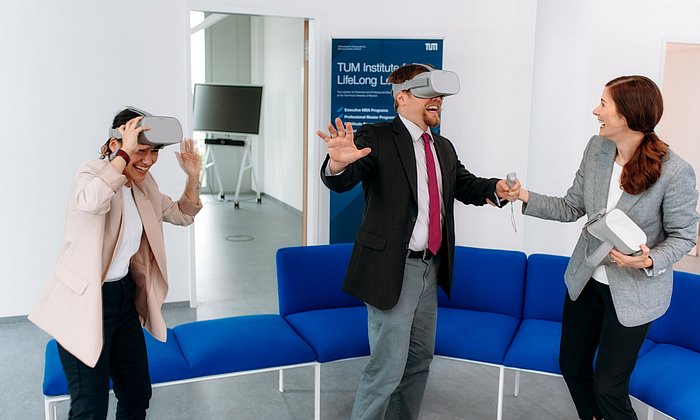
The TUM Institute for LifeLong Learning (TUM IL3) consolidates and coordinates all of the university's professional development and continuing education measures. The Institute opened in 2021 as part of the last Excellence Strategy phase (2019 - 2026). LifeLong Learning is becoming a central components of the TUM Agenda 2030+. Over 50,000 have received continuing education since 2021.
The Institute offers a wide range of diverse, individual and structured continuing education formats that promote the career empowerment of staff and professionals and support them in responsibly encountering the professional and societal challenges of today and tomorrow. The Institute makes a decisive contribution to effective teaching and learning at TUM by linking scientific research and technological innovation.
Together with UnternehmerTUM, we have established TUM Venture Labs, a unique incubator network that supports researchers and students starting entrepreneurial spin-offs in DeepTech fields such as Biotechnology, Artificial Intelligence, Quantum Sciences, Aerospace and Defense. In the TUM Agenda 2030+, TUM Venture Labs address the various different requirements of founding entrepreneurs with a wide range of specific programs, a broad network and the necessary infrastructure.
We've utilized the funding of our TUM Agenda 2030 future concept to expanded the technology-oriented humanities and social sciences and to reorganize previous internal structures to align them more closely with innovation: The narrowly defined disciplines of the Faculties have been replaced with seven Schools which are connected to one another via integrative research institutes and whose Departments cover the major scientific domains. In doing so we have taken leave of the principle of narrow discipline-based Faculties. The TUM Agenda 2030+ will continue to develop this matrix structure on an innovation-oriented basis.
The Schools' research and teaching activities are focused on people, nature and society – connected to one another across disciplines by integrative research institutes and other scientific facilities.
The TUM Institute for Advanced Study has grown to become an international marketplace of knowledge. It has been a core element in TUM’s Future Agenda since 2006.
- Fellowships: Approximately 200 excellent scientists have visited TUM-IAS as Fellows since 2007; they make up a lively global network for cutting-edge research.
- High risk – high gain: The Fellows team up with leading-edge TUM scientists in interdisciplinary focus groups to explore the emerging research fields of the future.
- Diversity of thought: In the exploration of new solution spaces TUM-IAS unites internationally renowned researchers and connects Munich with the world, talented young individuals with renowned leading scientists and the academic sector with business.
- Freedom for ideas: During their multi-year residence the Fellows are released from many responsibilities of the conventional everyday university life so that they can concentrate completely on their research.
- Knowledge transfer: TUM-IAS promotes scientific dialog between disciplines, nations and societies.
Since 2010 the TUM Graduate School, a central institution for the over 9,000 doctoral candidates at TUM, has stood for the targeted education of young scientific researchers. Under the auspices of the TUM-GS, the various Graduate Centers consolidate initiatives for supporting doctoral candidates under the highest international standards. This framework is the foundation the highest scientific performance and prepares doctoral candidates optimally for careers in science and industry. The TUM-GS model for success has evolved from the International Graduate School of Science and Engineering (IGSSE), which has been a part of the Excellence Strategy for many years.
This unique doctoral program model combines the following:
- Excellence in research: Individual research at the professorship or faculty remains the core element of the doctoral program.
- Subject-specific qualification: Numerous opportunities for subject-specific qualification ideally complement and reinforce independent scientific work.
- Interdisciplinary qualification: The comprehensive interdisciplinary course program gives talented young scientists the best possible preparation for professional challenges during and after the doctoral program.
- International experience: A diverse range of programs and funding possibilities facilitate international and cross-cultural collaboration in the early phases of research and promote the establishment of personal and institutional networks.
- Career advice: The TUM-GS offers custom-tailored counseling services providing optimum preparation for careers in science, industry and other fields.
In 2012 the TUM Faculty Tenure Track appointment and career system launched a paradigm shift in the appointment systems at German universities. This first real German Tenure Track system has made the TUM professorial teaching staff younger, more female and more international.
- Consistent career system: Within six years young scientists with excellent performance can advance from a temporary Assistant Professorship (W2) to a permanent Associate Professorship (W3) and then move on to a Full Professorship (W3+). This model was unique in Germany at the time of its introduction in 2012.
- Early independence: Assistant Professors are independent and develop their own research and teaching profiles from the very beginning. Assistant professors and all other professors are treated equally.
- Transparent advancement criteria: Excellent specialized performance in research and teaching is the sole and decisive criterion for advancement. TUM evaluates performance according to transparent and internationally established criteria.
- Family-oriented: Career and planning a family are easy to accommodate thanks to part-time professorships, parental leave semesters and Dual Career services.
- Successful program: By the end of 2022 TUM had appointed a total of 168 Tenure Track professors, several of them jointly with the Max Planck Society (MPG@TUM Program).
TUM Integrative Research Institutes consolidate intellectual and financial resources on an interdisciplinary basis and apply them to mission-driven transdisciplinary research focus areas with future potential.
- The Munich Center for Technology in Society (MCTS, 2012): The MCTS is an effective platform which connects technological sciences and their advances to societal issues, achieved through close collaboration between scientists from the social sciences and humanities with their counterparts from the natural sciences and technological sciences. In the School transformation of 2021 MCTS was advantageously moved to the Department of Science, Technology and Society at the new TUM School of Social Sciences and Technology.
- The Munich Institute of BioMedical Engineering (MIBE, 2015): Successor to the previous Munich School of BioEngineering (MSB), at the MIBE scientists from medicine, natural sciences and engineering sciences work on methods for prevention, diagnosis and treatment of illnesses. Their activities range from investigation of fundamental scientific principles to their application in medical devices, medications and computer programs.
- The Munich Institute of Integrated Materials, Energy and Process Engineering (MEP, 2022): Formerly part of the Munich School of Engineering (MSE, 2010), the MEP consolidates expertise in the fields of 4D materials and additive manufacturing technologies as well as biological production processes and process technologies and supports sustainable process design by integrating expertise on carbon-neutral energy systems.
- The Munich Institute for Robotics and Machine Intelligence (MIRMI, 2018): The MIRMI integrates leading-edge science in the field complexes of Artificial Intelligence, perception and robotics in a transdisciplinary approach, oriented towards the key issues of the future of mobility, work, health and environment.
- The Munich Design Institute (MDI, 2022): Currently under construction, the MDI links innovation-oriented practical design with TUM's scientific excellence. It works across boundaries in disciplines, in thought and in working cultures to generate a transdisciplinary cross-sectional impact on design with a focus on sustainable, human-centric innovations.
- The Munich Data Science Institute (MDSI, 2020): The MDSI pools the strengths of TUM in data sciences, machine learning and artificial intelligence (AI), from basic research to interdisciplinary applications. It will also teach data skills to master’s students, researchers and professionals.
- TUM Straubing Campus for Biotechnology and Sustainability (2017): An interdisciplinary focus on renewable resources, biotechnology and bioeconomy gives the TUM Straubing site a uniquely qualifying feature in research and teaching.
It can be taken for granted that scientific progress occurs internationally. It is just as much a matter of course for TUM to work to attract talented individuals from around the world, strategically expanding its international presence and global reputation.
- International talents: TUM actively searches for world-class talents to study or begin a research career at TUM. The program with which TUM invites talented postdoctoral students to Munich, even offering the best among them a research grant, is unique around the world.
- Strategic partnerships: TUM networks with leading universities, companies and funding organizations around the world, for example as a founding member of the EuroTech Universities Alliance, in the Global Alliance of Technological Universities and in Flagship partnerships. As members of the "TUM Asia Faculty", TUM professors regularly teach and conduct research in Singapore.
- Global presence: TUM initiates research and economic partnerships and exchange of scientists and students from all over the world, with liaison offices in Brussels, Mumbai, Beijing, San Francisco, São Paulo and Singapore.
- Host to the world: TUM connects its researchers with the brightest minds around the world and brings them to Munich, for example with its visiting professor program and Fellowships at the TUM Institute for Advanced Study (TUM-IAS).
Thinking and acting entrepreneurially also means appreciating, promoting and leveraging the gifts of talented individuals. The diversity of TUM's talents guarantees the high research performance and competitive strength of the entire university. Important steps up to now have been:
- Advancement through versatility: TUM leverages its innovative strength by challenging and supporting talented individuals in all their diversity. The Executive Vice President - Talent Management and Diversity promotes structures, processes and measures that further strengthen the diversity and equality of talented individuals. The Executive Vice President receives operative support from the Staff Unit Diversity & Inclusion.
- Intergenerational contract: TUM supports the exchange of the professional, life and worldly experience of its alumni and emeriti with school pupils, university students and young scientists. Outstanding and particularly dedicated retired professors accompany (Emeriti of Excellence, EoE) and help shape the further development of TUM as members of the "TUM Senior Excellence Faculty" (SEF).
- Education without borders: As members of the "TUM: Junge Akademie" the best students work on socially relevant projects.
- Alumni and mentoring: Today TUM's worldwide alumni network connects over 86,000 members with their alma mater. Many of these alumni actively support students and talented young individuals in mentoring programs.
- Fundraising: Friends of TUM and numerous sponsors in the TUM University Foundation improve the university's freedom of action with their financial support. TUM's Deutschlandstipendium student grant has supported over 7,000 students in the past 10 years.
- Children and youth: TUM's special laboratories and school programs inspire school pupils to get involved in natural sciences and technology – for example in the Student Research Center Berchtesgaden, at the TUM Kolleg or in the Deutsches Museum.
As an entrepreneurial university TUM supports its members on the way to the highest possible academic achievements. The services offered include:
- Acquiring externally funded projects: Advice and support in submitting funding requests
- Publication: Advice and financial support for publication in peer review journals
- Putting technologies on the market: Whether patents, licenses or your own company
- Founding start-ups: Active support from the first idea to the corporate growth phase
- Building partnerships with industrial partners and research institutions worldwide
- Continuing education: Structured additional qualification of employees
- Communication: Conveying your own research findings to the public
- Accommodating family and career: Advice and support from the family service as well as our own nursery schools and kindergartens