All News

The latest from studies, research and campus life.

Filter by categories (multiple selection possible):

Sustainability

We are committed to the sustainable transformation of society - scientifically, economically, environmentally and socially. Learn more about our sustainability strategy.
Sustainability goals

With local hydrogen storage facilities, industry can become cleaner, as is the case here in the Chemical Triangle of southeastern Bavaria.
4/10/2026
Reading time: 3 Min.

Study shows alternatives to salt caverns in northern Germany

Major hydrogen storage potential in Bavaria

Geological formations in southern Bavaria offer a previously underestimated potential for storing large quantities of hydrogen. They could therefore be an alternative to salt caverns in northern Germany and thus contribute to a better geographical distribution of storage capacities. This is the conclusion of a study conducted by the Technical University of Munich (TUM) in cooperation with the Technical University of Leoben (MUL) on behalf of the Bavarian Ministry of Economic Affairs.

Research Sustainability Energy
3/27/2026
Reading time: 3 Min.

TUM researchers uncover how solar cells age and develop solution

Making perovskite solar cells weather-resistant

Perovskite solar cells are widely seen as the next big leap in photovoltaics. These devices use a special class of crystalline materials that convert sunlight into electricity with exceptional efficiency. However, their sensitivity to temperature swings has slowed their path to our rooftops. Researchers at the Technical University of Munich (TUM) and the Cluster of Excellence e-conversion have now identified why these promising materials lose their performance – and how they can be stabilized.

Research Sustainability Energy
3/23/2026
Reading time: 8 Min.

Technologies for sustainable space travel

Resource efficiency in space

From lower-emission propulsion systems and servicing robots to photobioreactors for autonomous life support, researchers at TUM are developing technologies to make spaceflight more sustainable. They aim to balance growth with responsibility and ensure the long-term use of the orbit.

TUM Magazine Research Entrepreneurship Sustainability
Tree trunks with clearly visible bark beetle damage: large areas of bark are missing, and the trunks appear severely affected.
3/5/2026
Reading time: 3 Min.

Forest damage could double

How fires, storms, and bark beetles will shape the future of Europe’s forests

Wildfires, storms, and bark beetles have a major impact on forests and the benefits they provide for people and the environment. For the first time, a large international team led by researchers at the Technical University of Munich (TUM) has calculated how disturbances could transform Europe’s forests by 2100. Even in the most optimistic scenario, the team foresees a substantial increase in damaged forest area—in the most pessimistic case, disturbances could even double.

Research Sustainability
Professor Jia Chen can be seen from a distance, standing under a bridge. The large glass front of a building can be seen in the background.
3/3/2026
Reading time: 2 Min.

Climate impact of urban vegetation visible in detail for the first time

Urban trees can absorb more CO₂ than cars emit during summer

How much carbon dioxide do parks and individual trees in cities absorb, and how much do they release? To answer this question, researchers at the Technical University of Munich (TUM) have developed a high-resolution CO₂ biogenic flux model. Their findings show that, on average, around two percent of Munich's annual urban emissions are compensated by vegetation. Urban trees have the greatest impact, whereas grassy areas are often net sources of CO₂.

Research Sustainability
2/25/2026
Reading time: 2 Min.

Neutrons from FRM II help investigate the processes involved in coral death

Why corals bleach

Rising sea temperatures are causing coral reefs around the world to bleach. For the first time, a research team at the Research Neutron Source Heinz Maier-Leibnitz (FRM II) at the Technical University of Munich (TUM) has investigated the biological processes behind coral bleaching directly in living corals. With the help of neutrons, they were able to visualise structural changes during the bleaching process.

Research Sustainability
2/23/2026
Reading time: 1 Min.

Media tip: TV report on the TUM Garching Plant Fire Brigade

Electrically Powered to the Scene

Sustainability is of particularly high importance at the Technical University of Munich (TUM) – not only in research and teaching, but naturally also in campus operations. Safety at the TUM Research Campus in Garching is ensured by the university’s own professional plant fire brigade, which now operates Bavaria’s first electrically powered fire engines.

Campus news Sustainability Community
2/20/2026
Reading time: 2 Min.

Sustainability Project in Partnership with Dominikus-Ringeisen-Werk

TUM Supports Innovation Campus for Circular Bioeconomy

To strengthen regional energy and resource security, the Technical University of Munich (TUM) is partnering with Dominikus-Ringeisen-Werk (DRW). As part of the joint project “Living Lab Circular Bioeconomy,” an innovation campus is being established at the headquarters of the church-affiliated foundation in Ursberg, a historically significant monastery site. Around 1,000 people with support needs live there.

Research Sustainability Energy
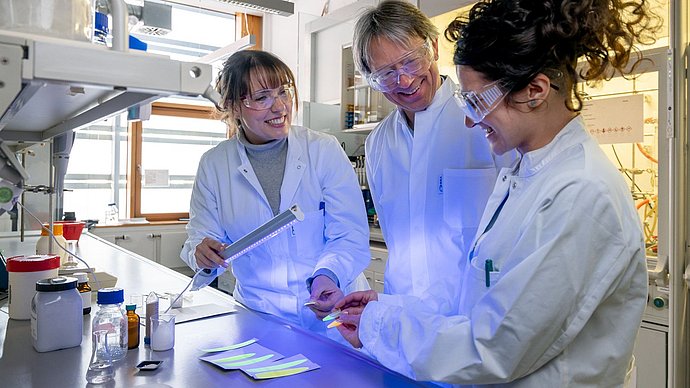
Group photo: Skopp, Sieber, and Marosevic in the lab with purified protein showing the color differences.
2/12/2026
Reading time: 3 Min.

Functional coating made from proteins and bacteria

Living material makes harmful UV-light visible

T-shirts that warn of excessive sun exposure or labels that reveal damage to light sensitive materials: researchers at the Technical University of Munich (TUM) have developed a coating that makes this possible—using proteins and bacteria. The coating reliably detects contact with UV-A radiation, is bio based, and could open the door to a wide range of new materials that draw on the biological functions of cells.

Research Sustainability
Es sind gelb blühende Rapspflanzen auf einem Feld zu sehen. Im Hintergrund sind einzelne Bäume zu erkennen.
2/3/2026
Reading time: 1 Min.

Less fertilizer, better growth

Probiotics for Plants

Researchers at the Technical University of Munich (TUM) have identified a bacterial genus that promotes root growth and nitrogen uptake in plants. The findings open new possibilities for developing customized “plant probiotics” that could contribute to more resource-efficient agriculture by reducing the need for nitrogen fertilizer.

Research Sustainability
Loader

Contact

Corporate Communications Center
Public Relations Team
Arcisstraße 21
80333 Munich
Tel. 089/289-22778
Fax 089/289-23388
pressespam prevention@tum.de

Team

HSTS